 Book Printing in China
 Custom Card Decks
 Custom Holographic Cards
 Free Wall Calendar Template
 Free Desk Calendar Template
 Folding Cartons
 Rigid Boxes
 Corrugated Boxes
 Custom Board Game
 Custom Card Game
 Kickstarter Print Solutions
Grayboard
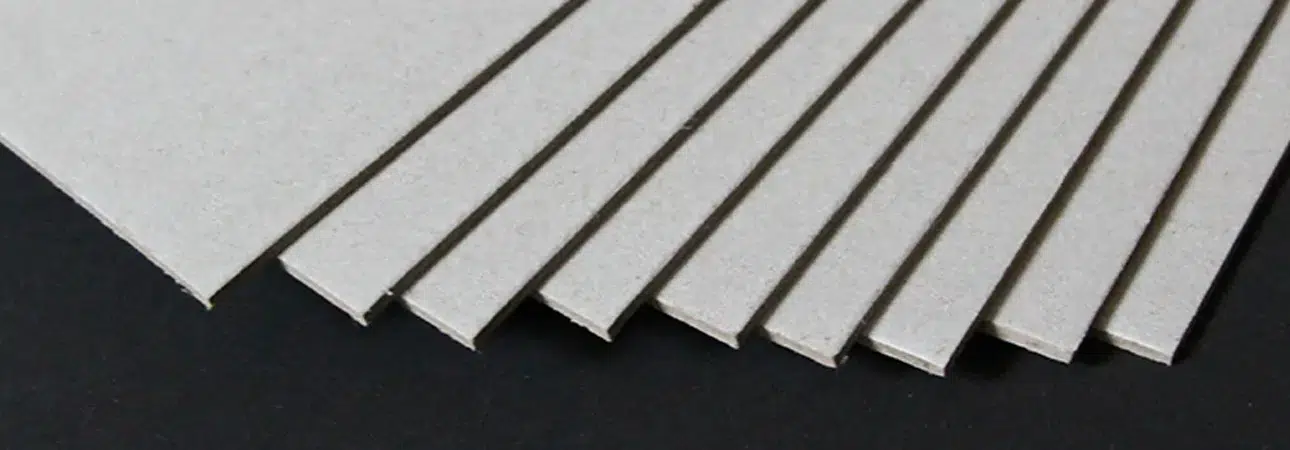
Grayboard (also called chipboard or bookboard) is a dense, rigid board made from layers of compressed recycled fiber. It is the structural backbone of hardcover books, rigid boxes, game boards, game screens, and tiles. Grayboard is not printed directly; instead, printed paper, cloth, leather, or other cover materials are wrapped or laminated onto its surface to create the finished product.
The board itself is a uniform gray color throughout, with a smooth, matte surface on both sides. It holds its shape under pressure, resists warping, and provides the solid, premium feel that distinguishes hardcover and rigid box products from lighter alternatives.
Available Thicknesses
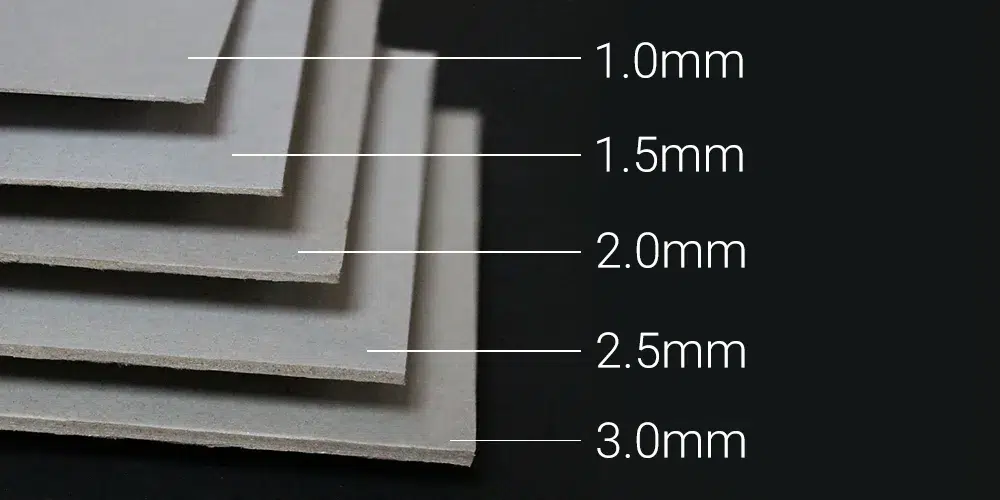
We offer grayboard in five standard thicknesses. The right choice depends on the product type, finished size, and the level of rigidity required.
| Thickness | Typical Applications | Notes |
|---|---|---|
| 1 mm | Tiles, lightweight components | Wrapped on 250 gsm C1S paper with varnish on both sides. Used for game tiles and similar thin, rigid components. |
| 1.5 mm | Tiles, lightweight components | Same construction as 1 mm. Wrapped on 250 gsm C1S paper with varnish on both sides. Provides slightly more rigidity for larger tiles. |
| 2 mm | Game boards, game screens, smaller rigid boxes, small hardcover books | Suitable for game boards and game screens, smaller rigid boxes, and hardcover books with a finished trim size up to approximately 150 mm × 150 mm (about 6″ × 6″). |
| 2.5 mm | Medium hardcover books, mid-size rigid boxes | The standard choice for hardcover books up to approximately 8.5″ × 11″ (216 mm × 279 mm) and medium-sized rigid boxes. Provides a sturdy, professional feel without excessive weight. |
| 3 mm | Large hardcover books, large rigid boxes | Required for hardcover books at 8.5″ × 11″ or larger and large rigid boxes. The extra thickness prevents cover warping on oversized formats and provides maximum structural rigidity. |
Common Applications
- Hardcover book cases: grayboard forms the rigid front and back covers, wrapped in printed paper, cloth, or leather.
- Rigid boxes: grayboard panels are wrapped with printed paper or specialty materials to create premium telescope boxes, magnetic closure boxes, collapsible boxes, and shoulder-neck boxes.
- Game boards: grayboard is laminated with printed paper on both sides and scored to create foldable game boards.
- Game screens and player shields: grayboard panels hinged together and wrapped with printed art.
- Tiles and tokens: thin grayboard (1–1.5 mm) wrapped in printed C1S paper, die-cut into individual pieces.
Wrapping and Finishing
Grayboard is always covered with another material before it reaches the end user. The most common wrapping options include printed paper (coated, uncoated, or specialty stocks), cloth (book cloth in a wide range of textures and colors), leatherette or PU leather, and metallic or holographic papers. The wrapping material is adhesive-bonded to the grayboard surface, with edges turned and tucked for a clean finish.
Finishing techniques such as foil stamping, embossing, spot UV, and lamination are applied to the wrapping material, not to the grayboard itself. The exception is debossing (and foil-stamped debossing): these must be performed after the wrapping material has been bonded to the grayboard, because the die presses through both the surface material and the board together to create the impression.
How to Choose the Right Thickness
Selecting the correct grayboard thickness comes down to two factors: what you are making and how large it is. Thinner boards (1–1.5 mm) are appropriate for small, flat components like tiles. Mid-range boards (2–2.5 mm) handle most hardcover books and rigid boxes. The heaviest board (3 mm) is reserved for large-format books and oversized boxes where rigidity and warp resistance are critical. One additional consideration: for leatherette-wrapped covers, choose a thinner grayboard than you would for book cloth or printed paper wraps. Leatherette is thicker than paper or cloth, so pairing it with heavy grayboard can make the cover feel bulky and less refined. Stepping down one thickness grade keeps the finished product looking clean and proportional.
If you are unsure which thickness is right for your project, contact us at [email protected] with your product type and dimensions. We will recommend the best option and can provide a sample for evaluation.
Related Resources