 Book Printing in China
 Custom Card Decks
 Custom Holographic Cards
 Free Wall Calendar Template
 Free Desk Calendar Template
 Folding Cartons
 Rigid Boxes
 Corrugated Boxes
 Custom Board Game
 Custom Card Game
 Kickstarter Print Solutions
Painted, Sprayed & Fore-Edge Printing

Painted edges—also called edge printing, sprayed edges, or colored edges—refers to any decorative color treatment applied to the trimmed edges of a book’s or card deck’s page block. Unlike gilded edges (which use metallic foil), painted edges use ink to add solid colors, gradients, patterns, or even full illustrations to the exposed edges.
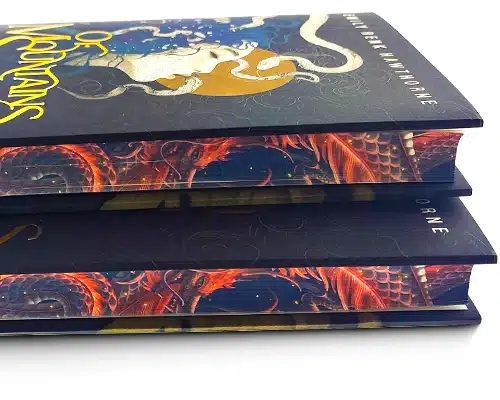
The color is applied digitally using spray equipment after the pages have been trimmed and clamped. Because the process is digital spray rather than traditional offset printing, it doesn’t use Pantone inks in the conventional sense—but we can match virtually any color you specify, whether you provide a Pantone reference number, a CMYK value, or a hex code. The result is a clean, consistent color that matches your design intent.
The effect is visible when the book or deck is closed, transforming what would otherwise be a plain white or off-white edge into a distinctive design element.
Ready to print custom painted edges on your book? We do solid colors, gradients, and printed-image edges from 100 copies. Get an instant price →
Types of Painted Edges
Solid color edges: A single, uniform color is applied to one or more edges of the page block. Bold, clean, and instantly recognizable—this is the most popular and versatile option.
Gradient edges: A smooth color transition (for example, red to purple, or blue to teal) is sprayed across the edge, creating a modern, eye-catching effect.
Sprayed edges: Ink is sprayed in a looser, more organic pattern to produce speckled, splatter-style, or textured effects. This technique allows for creative, one-of-a-kind results.
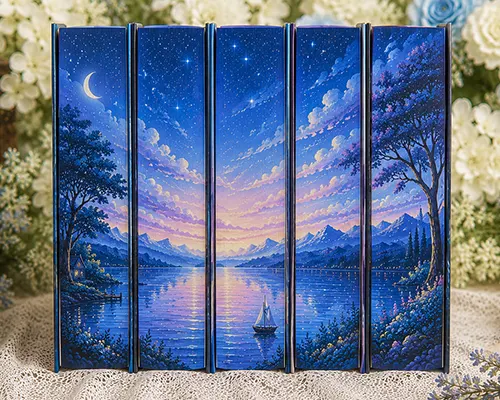
Patterned and illustrated edges: A printed image or repeating pattern is applied to the fore-edge (the edge opposite the spine) so that a design is visible when the book is closed. When the pages are fanned, the image appears to animate. This is the most complex and visually dramatic option.
Themed edge artwork: Seasonal, event-specific, or IP-based designs applied to the edges—popular for holiday editions, convention exclusives, and licensed collaborations.
Cover-matched edges: The edge color is coordinated with the cover design, creating a cohesive, unified look when the book is viewed from any angle. This is especially effective for books displayed face-out on retail shelves.
How Painted Edges Are Applied
All painted edge techniques are applied after the interior pages have been printed, collated, and trimmed into a clean page block:
- The trimmed block is clamped tightly to create a flat, uniform surface.
- For solid colors and gradients, ink is applied using digital spray equipment with precise masking to control coverage.
- For patterned or illustrated edges, the image is printed onto the clamped edge surface using a specialized method.
- The block is allowed to dry completely before binding.
The quality of painted edges depends on the evenness of the trim and the precision of the clamping. A perfectly flush, tightly compressed block produces the sharpest, most consistent results.
Requirements: Painted edges require a minimum spine width of 10mm and must be printed on uncoated offset paper. If you’re unsure whether your project qualifies, share your specs and we’ll confirm.
An Important Note on Bleed Colors
Unlike gilded edges—where a layer of metallic foil completely covers the edge surface—painted edges are sprayed directly onto the exposed paper fibers. This means the bleed colors from your interior pages or card faces will show through and affect the final appearance of the sprayed edge color.
This is especially noticeable when spraying a light edge color over pages or cards with dark bleed areas. If your interior artwork bleeds black or a very dark color to the edge, a light-colored spray will appear significantly darker and muddier than intended, because the dark ink underneath mixes visually with the sprayed color on top.
To get the cleanest, most accurate painted edge color, design your interior pages with white or light-colored bleeds wherever possible—or choose an edge color that is dark enough to mask the underlying bleed. If you’re unsure how your bleed colors will interact with your chosen edge color, our team can advise before production begins.
Popular Applications
- Special edition books: Painted edges are one of the most popular upgrades for limited editions, author exclusives, and collector’s items. A matching edge color ties the cover design to the interior and creates a cohesive, premium object.
- Indie and crowdfunded publishing: Kickstarter-backed novels and art books frequently use painted or sprayed edges to differentiate backer reward tiers.
- Novels and literary fiction: Most novels and text-heavy books are printed on uncoated offset paper by default, making them ideal candidates for painted edges. It’s one of the most effective ways to elevate a standard trade paperback or hardcover into something distinctive.
Multi-volume sets and box sets: Coordinated edge colors across a series create a striking visual when the books are shelved together.
Design Considerations
- Color specification: Tell us the color you want and we’ll match it. You can provide a Pantone reference number, a CMYK value, a hex code, or even a physical sample. Since painted edges are applied by digital spray rather than offset printing, the result is a close visual match rather than a true Pantone spot-color print—but for edge finishing, the difference is not perceptible.
- Gradient directions: Specify which direction the gradient should flow and the start and end colors.
- Illustrated edge files: For patterned or illustrated edges, you’ll need to provide a separate artwork file sized to the exact edge dimensions (height × thickness of the page block). We can provide templates.
- Paper absorbency: Uncoated papers absorb edge ink more readily, which can produce a softer, slightly more muted result. Coated stocks—including matte and gloss art paper—are not compatible, as the ink does not bond reliably to coated surfaces.
- Variable runs: We support variable edge colors within a single print run—for example, 500 copies with red edges and 500 with blue—making it easy to create multi-tier editions.
- Light edge colors and dark bleeds: If you’re planning a light-colored painted edge, avoid designing your interior pages with dark colors bleeding to the trim edge. As explained above, the dark bleed ink will show through and shift the final edge color. Either adjust your interior bleeds to white or light tones, or choose a darker edge color that won’t be affected.
Painted Edges vs. Gilded Edges
Painted edges and gilded edges are both applied to the trimmed page block, but they produce very different effects. Gilded edges use metallic foil for a reflective, mirror-like finish in gold, silver, or other metallic tones. Painted edges use ink and can reproduce any solid color, gradient, pattern, or illustration. Choose gilded for classic luxury and painted for modern design versatility.
Not sure which edge treatment is right for your project? Order a sample pack and see the options firsthand.
Related Resources