 Book Printing in China
 Custom Card Decks
 Custom Holographic Cards
 Free Wall Calendar Template
 Free Desk Calendar Template
 Folding Cartons
 Rigid Boxes
 Corrugated Boxes
 Custom Board Game
 Custom Card Game
 Kickstarter Print Solutions
Infrared Varnish
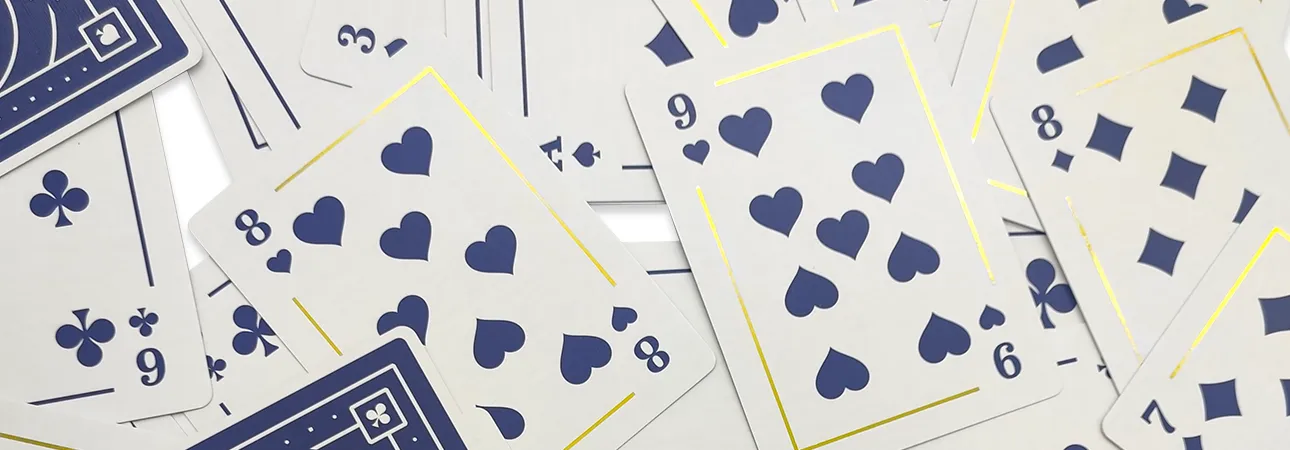
Infrared varnish—also known as poker varnish in the printing industry—is an inline coating specifically developed for playing cards and card decks. It is applied on the offset printing press during the same pass as CMYK printing, following the same inline production process as inline UV varnish. The key difference is the curing method: instead of ultraviolet light, the coating is cured by passing through an infrared heat tunnel at the end of the press.
The result is a surface with a distinctively smooth, silky feel. Cards coated with infrared varnish glide over each other effortlessly, making the deck easy to shuffle, fan, and deal. This is why the coating earned its nickname—poker varnish—and why it is the standard finish for professionally produced playing cards and card decks worldwide.
How Infrared Varnish Works
The production process is identical to inline UV varnish up to the curing stage. The sheet passes through the CMYK ink units on the offset press, then enters an additional coating unit where the varnish is applied across the entire sheet as a flood coat — covering the full surface front and back when both sides are printed. The difference comes at the end of the press: instead of a UV light tunnel, the coated sheet passes through an infrared heat tunnel that dries and cures the coating.
Infrared curing produces a coating with different physical properties than UV curing. Where UV-cured coatings are hard and glossy, infrared-cured coatings are smooth and slippery. The surface has a low coefficient of friction, which is the technical way of saying the cards slide against each other easily. This low-friction surface is what makes infrared varnish the preferred finish for any card product that will be handled, shuffled, or fanned during use.
Why Infrared Varnish Feels Different
The silky feel of infrared varnish is not just a matter of gloss level—it is a fundamentally different surface texture. UV-cured coatings and aqueous coatings produce surfaces that are smooth to the eye but have enough microscopic grip that cards can feel slightly sticky or resistant when shuffled. Infrared-cured varnish produces a surface that is genuinely slippery to the touch, with minimal friction between card faces.
This difference matters most during gameplay. A well-shuffled deck should riffle cleanly, fan evenly, and deal without cards catching or clumping. Infrared varnish is formulated specifically to achieve this. It is not a general-purpose coating adapted for cards—it is a coating designed from the ground up for card handling.
Flood Application Only
Infrared varnish is a flood-only coating. It covers the entire surface of the card on both front and back, ensuring every card in the deck has a uniform silky feel for consistent shuffle performance. There is no variation in friction between coated and uncoated areas — exactly what is needed for smooth card handling.
Specifications
| Specification | Detail |
|---|---|
| Process | Inline — applied on the offset press during CMYK printing |
| Curing method | Infrared (IR) heat curing |
| Finish | Silky smooth, low-friction gloss |
| Application | Flood only (entire card surface, both sides). Spot application is not available. |
| Paper weight range | 250–350 gsm |
| Surface feel | Silky, slippery — designed for easy card shuffling and handling |
| Protection level | Moderate — good resistance to fingerprints and surface wear |
| Also known as | Poker varnish |
Common Applications
- Playing cards — standard 54-card poker and bridge decks where shuffle quality is essential.
- Game cards — card decks for tabletop games, TCGs, and party games where cards are frequently shuffled and dealt.
- Tarot cards — 78-card tarot decks where smooth card handling enhances the reading experience.
- Oracle cards — divination and spiritual card decks used in spreads and shuffled between readings.
- Any card deck where the cards will be shuffled, fanned, or dealt repeatedly during use.
When to Use Infrared Varnish
- Your card deck will be shuffled during use — this is the defining criterion.
- You want the smoothest possible card-to-card feel for gameplay or card handling.
- You are producing playing cards, game cards, tarot cards, or any deck where shuffle quality directly affects the user experience.
Infrared Varnish vs. Aqueous Coating for Card Decks
These are the two most common finishing options for card decks. The choice depends on how the deck will be used.
| Infrared Varnish | Aqueous Coating | |
|---|---|---|
| Process | Inline (on the press) | Offline (separate machine) |
| Surface feel | Silky, slippery — cards glide easily | Smooth but with slight grip — cards feel more "substantial" in hand |
| Shuffle quality | Excellent — designed for shuffling | Adequate but not as smooth |
| Coating thickness | Medium | Thick — heavier coating |
| Spot application | No — flood only | No — flood only |
| Sides coated | Both sides | Both sides |
| Best for | Playing cards, game cards, any deck shuffled during use | Tarot, oracle, affirmation, and therapy cards held in hand without frequent shuffling |
Many card deck creators choose infrared varnish as the default because it covers the widest range of use cases—even decks that are not heavily shuffled benefit from the smooth handling. Aqueous coating is typically chosen when the creator specifically wants a slightly textured, grippier feel for their cards.
Frequently Asked Questions
Why is it called poker varnish?
Because this coating was originally developed for poker cards and playing cards. The silky, low-friction surface makes cards easy to shuffle, riffle, and deal—essential qualities for playing card production. The name has stuck in the industry even though the varnish is now used for all types of card decks.
Is infrared varnish only available in gloss?
In practice, yes. Infrared varnish produces a smooth, glossy finish. There is no matte version because the purpose of this coating is to create a slippery surface for card handling, and matte finishes inherently have more texture and friction.
Can I use infrared varnish on both sides of the card?
Yes. For card decks, both sides of every card are coated to ensure consistent feel and shuffle performance.
Does infrared varnish protect cards from wear?
Yes. Infrared varnish provides moderate protection against fingerprints, surface scuffing, and light moisture. For maximum durability, some card producers also add lamination before varnishing, though this is not common for standard card decks.
What cardstock works best with infrared varnish?
Infrared varnish is typically applied to 300/350 gsm premium cardstock or 310 gsm black core cardstock. Both work well. Black core cardstock is recommended for any deck where the card content must remain hidden from the back (playing cards, game cards with hidden information).
Can infrared varnish be combined with foil stamping or spot UV?
Foil stamping can be applied on top of infrared varnish without issue. Spot UV is technically possible alongside infrared varnish, but it is generally not effective: both surfaces are glossy, so the spot UV areas do not stand out against the already-shiny varnished background. (Note: this refers to offline spot UV applied as a separate step. Infrared varnish itself is flood coat only.) For a visible spot UV effect, a matte base finish works much better.
Can infrared varnish be combined with a linen or textured finish?
Yes. Many playing cards and game cards are produced with infrared varnish first, then embossed with a linen or textured pattern in a separate pass. The texture adds grip and a premium tactile feel while the infrared varnish beneath still provides a smooth card-to-card glide during shuffling. This combination is very common in professional playing card production.
Can infrared varnish be applied as a spot coat on selected areas of the card?
No. Infrared varnish is a flood-only coating — it covers the entire card surface in a single uniform layer. This is by design: a uniform low-friction surface is essential for consistent shuffling, and partial coating would create areas of higher friction where cards could catch on each other. For spot effects on cards (raised highlights, glossy logos), use offline spot UV after varnishing.
Producing a card deck? Contact us at [email protected] to discuss the best finishing option for your cards. We can provide sample decks with infrared varnish and aqueous coating so you can feel the difference before committing.
When to Consider Other Options
- Card decks not shuffled? → Aqueous Coating
- Book interiors? → Overprint Varnish or Inline UV Varnish
- Metallic or specialty cardstock? → UV Coating
- Packaging? → UV Coating or Aqueous Coating
- Need spot coating (selected areas only)? → Overprint Varnish, UV Coating, Spot UV