 Book Printing in China
 Custom Card Decks
 Custom Holographic Cards
 Free Wall Calendar Template
 Free Desk Calendar Template
 Folding Cartons
 Rigid Boxes
 Corrugated Boxes
 Custom Board Game
 Custom Card Game
 Kickstarter Print Solutions
Aqueous Coating
Aqueous coating is a water-based protective coating applied offline after CMYK printing, making it one of the most environmentally friendly finishing options available. It produces a noticeably thicker, more protective layer than inline varnishes, with good resistance to scratching, scuffing, and handling wear. Available in gloss and matte, it is a flood-only process that covers the entire sheet surface.
In the print industry, aqueous coating is what is commonly referred to as “varnishing.” It is the standard choice when a protective coating finish is required, and the default finish for card decks where a clean, durable surface is needed without specialty coatings.
How Aqueous Coating Works
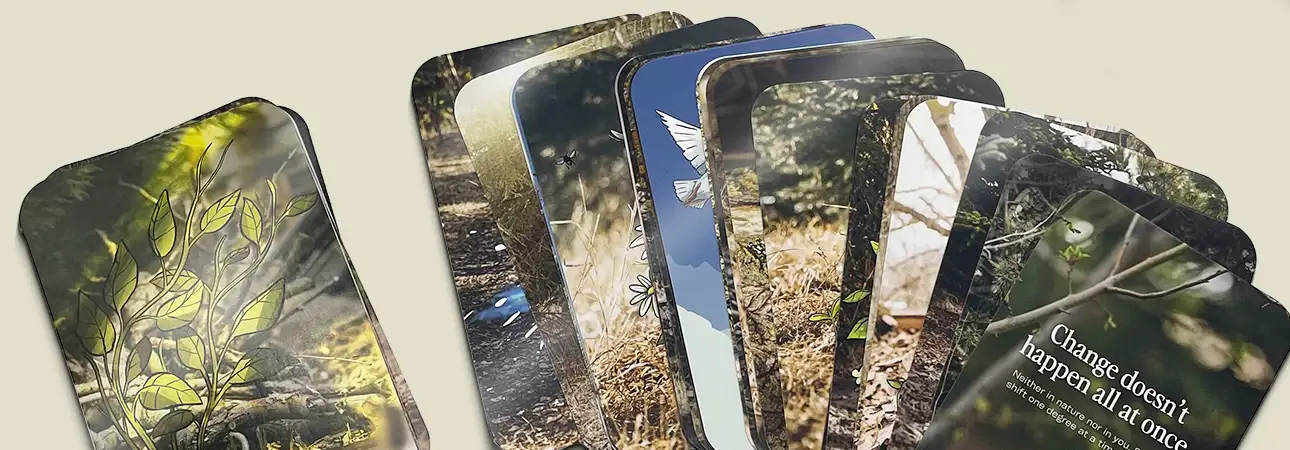
After the sheets are printed in CMYK on the offset press and allowed to dry, they are transferred to a separate coating machine. The sheet passes between two rollers: one roller carries the aqueous coating and transfers it onto the paper surface as the sheet feeds through. The coated sheet then moves along a conveyor belt through a drying section where heat and air evaporate the water content, leaving a solid protective film on the paper surface. For double-sided aqueous coating, the sheet goes through this process twice — once for each side.
Because this is an offline process — a completely separate production step from printing — the coating is applied to an already-dried ink surface rather than wet-on-wet. This means the coating sits on top of the ink layer as a distinct film. The result is a thicker, more protective coating compared to inline varnishes, but with a trade-off: the surface may not be as perfectly smooth as inline varnish. Matte aqueous coating in particular may show light streaking, because the matte formulation is thicker and more viscous than the gloss version — as the sheet passes between the two rollers, the heavier coating is squeezed slightly unevenly, leaving faint directional marks on the surface.
Aqueous coating can be applied to one side or both sides of the sheet. For card decks, double-sided coating is standard.
Finish Options
Gloss Aqueous Coating
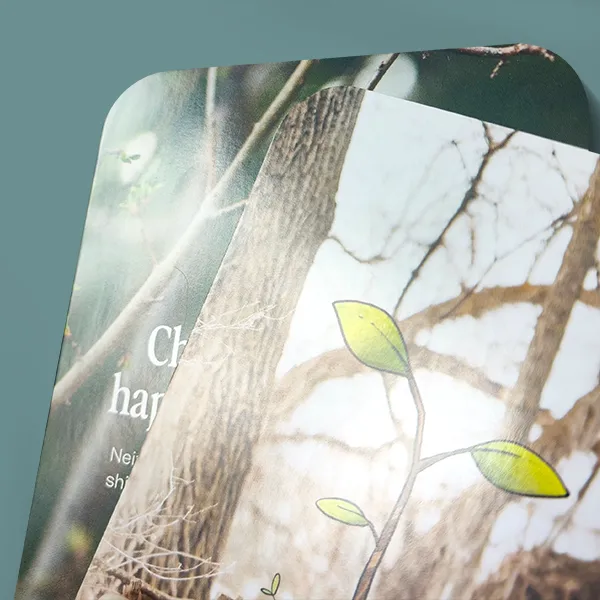
Gloss aqueous coating produces a bright, reflective surface. The gloss level is higher than overprint varnish and comparable to inline UV varnish, though the surface texture may be slightly less uniform due to the offline application method. Gloss aqueous coating enhances color vibrancy and gives cards a polished, professional appearance.

Matte Aqueous Coating
Matte aqueous coating produces a soft, non-reflective surface with a smooth but slightly textured feel. Light streaking is visible on matte aqueous coating — this occurs because the matte formulation is thicker and more viscous than gloss. As the sheet passes between the two coating rollers, the heavier matte coating is squeezed unevenly, resulting in faint surface lines. This is a normal characteristic of matte aqueous coating and is not a defect. Matte aqueous coating is chosen when a subdued, elegant look is preferred over high gloss.
Flood Coating Only
Aqueous coating is a flood-only process. The coating machine applies the varnish across the entire surface of the sheet—there is no way to mask or exclude specific areas. If your project requires coating on selected areas only (spot coating), the available options are overprint varnish (for book interiors on 80–200 gsm paper), spot UV (for raised highlights on covers and premium printed products), or UV coating / sand UV coating on a UV offset press (for specialty cardstock such as metallic, pearlescent, or soft-touch).
Specifications
| Specification | Detail |
|---|---|
| Process | Offline — applied on a separate coating machine after printing |
| Coating material | Water-based coating |
| Drying method | Heat and air evaporation |
| Finish options | Gloss, matte |
| Application | Flood only (entire surface). No spot coating. |
| Sides | Single side or both sides. Double-sided is standard for card decks. |
| Paper weight range | 200 gsm and above. Thinner paper will curl or wrinkle. |
| Coating thickness | Thick — noticeably thicker than all inline varnish options |
| Protection level | High — strong scratch and scuff resistance on both sides |
| Surface smoothness | Good but not as uniform as inline varnish. Matte may show light streaking. |
| Cost | Approximately 1.3× inline UV varnish |
Common Applications
- Card decks (double-sided coating) — tarot cards, oracle cards, affirmation cards, therapy cards, and any deck where cards are held in hand rather than shuffled aggressively.
- Flash cards and educational cards — durable coating on both sides for repeated handling by students and children.
- Thick postcards and greeting cards — flood coating for surface protection and a polished finish.
- Premium printed products on 200+ gsm stock where stronger protection than inline varnish is needed.
When to Use Aqueous Coating
- Your card deck will be held in hand and drawn one at a time, but not shuffled frequently — tarot spreads, oracle readings, affirmation draws, therapy sessions.
- You want thicker, more durable protection than inline varnish can provide.
- You need both sides of the card coated in the same production run.
- You prefer a slight grip when holding cards, rather than the slippery feel of infrared varnish.
Aqueous Coating vs. Infrared Varnish for Card Decks
This is the most common comparison for card deck finishing. The choice comes down to how the deck will be used.
| Aqueous Coating | Infrared Varnish | |
|---|---|---|
| Process | Offline (separate machine) | Inline (on the press) |
| Surface feel | Smooth with slight grip — cards feel substantial in hand | Silky, slippery — cards glide easily |
| Shuffle quality | Adequate but not as smooth | Excellent — designed for shuffling |
| Coating thickness | Thick — heavier coating, stronger protection | Medium |
| Spot application | No — flood only | No — flood only |
| Sides coated | Both sides (standard) | Both sides |
| Matte option | Yes | No |
| Best for | Tarot, oracle, affirmation, therapy cards — held in hand, drawn one at a time | Playing cards, game cards — shuffled, riffled, dealt during play |
Why 200 gsm Minimum?
The aqueous coating process requires the sheet to pass between two rollers, one of which transfers the coating onto the paper. If the paper is too thin, it will wrinkle or crease as it passes through the roller gap — especially because one roller is wet with coating material. Only paper of 200 gsm or above has enough rigidity to pass through smoothly without wrinkling. In addition, aqueous coating is a water-based process. When the coating is applied, the water content temporarily softens the paper surface before evaporating during the drying stage. On thick paper (200 gsm and above), the paper is rigid enough to absorb this moisture without warping, curling, or wrinkling. On thinner paper (below 200 gsm), the moisture causes the sheet to curl or develop wavy edges, making the finished product unusable.
This is the fundamental reason aqueous coating is not used for book interiors—most interior pages are printed on 80–157 gsm paper, which is too thin for this process. For book interiors, use inline varnishes (overprint varnish or inline UV varnish), which are applied and cured on the press without introducing moisture to the sheet.
Frequently Asked Questions
Why does matte aqueous coating show streaking?
The streaking occurs because the matte coating formulation is thicker and more viscous than the gloss version. During application, the sheet passes between two rollers — one roller transfers the coating onto the paper surface. The heavier matte coating is squeezed slightly unevenly as it passes through the roller gap, leaving faint directional marks on the surface. On gloss coating, the high sheen masks these marks. On matte coating, the non-reflective surface makes them visible. This is a normal characteristic of matte aqueous coating and is not a defect.
Can I apply aqueous coating to one side only?
Yes. Single-sided aqueous coating is possible and is used for products like postcards or greeting cards where only the printed side needs protection. For card decks, double-sided coating is standard.
Does aqueous coating affect color accuracy?
Gloss aqueous coating slightly enhances color saturation and contrast, making colors appear more vivid. Matte aqueous coating slightly mutes colors and reduces contrast. Neither significantly alters the printed color—the effect is subtle.
Can aqueous coating be applied over foil stamping or spot UV?
Aqueous coating is typically applied as the final finishing step. It can be applied over a surface that has already been foil-stamped or spot UV coated.
What is the difference between aqueous coating and lamination?
Aqueous coating is a liquid coating that dries into a protective film on the paper surface. Lamination is a separate plastic film bonded onto the sheet. Lamination provides stronger protection, higher gloss, and greater durability, but it changes the feel of the product. For card decks, aqueous coating is the standard. Lamination is used for water-proof card decks, book covers, and packaging where maximum durability is required.
Not sure whether aqueous coating or infrared varnish is right for your card deck? Contact us at [email protected]. We can provide sample cards with both finishes so you can feel the difference and decide which suits your product.
When to Consider Other Options
- Shuffling required → Infrared Varnish
- Book interiors → Overprint Varnish or Inline UV Varnish
- Need spot coating (selected areas only)? → Overprint Varnish, UV Coating, Spot UV
- Metallic or specialty cardstock → UV Coating
- Maximum durability on covers or packaging → Gloss Lamination