 Book Printing in China
 Custom Card Decks
 Custom Holographic Cards
 Free Wall Calendar Template
 Free Desk Calendar Template
 Folding Cartons
 Rigid Boxes
 Corrugated Boxes
 Custom Board Game
 Custom Card Game
 Kickstarter Print Solutions
Corrugated Board
Corrugated board is a structured paperboard made from a fluted (wavy) inner layer sandwiched between flat outer liners. The fluted core gives the material its strength: it absorbs impact, resists crushing, and cushions the contents, while keeping the overall weight low enough to minimize shipping costs.
Unlike solid grayboard or cardstock, corrugated board is engineered for transit protection. It is the standard material for shipping boxes, mailer boxes, display packaging, master cartons, and any application where the box must survive handling, stacking, and transport before reaching the end customer.
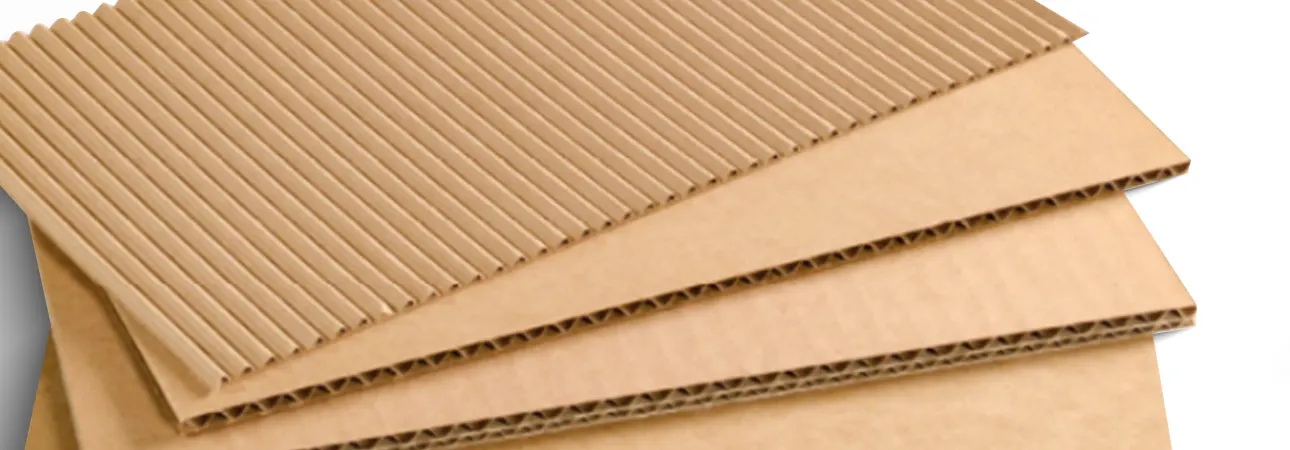
Flute Types
The flute is the wavy middle layer that gives corrugated board its rigidity and cushioning. Different flute profiles offer different balances of thickness, strength, and print surface quality. The following are the most common flute types we use, with their specifications and typical applications for reference.
| Flute | Thickness | Flutes/m | Strength | Typical Use |
|---|---|---|---|---|
| E flute | ~1.5 mm | 290–320 | Light | Retail folding cartons, cosmetic boxes, small electronics packaging. Thin and smooth enough for high-quality direct printing. |
| B flute | ~3 mm | 150–185 | Medium | Mailer boxes, inner packaging, die-cut retail displays. Good crush resistance with moderate thickness. |
| C flute | ~4 mm | 120–145 | High | Shipping boxes, master cartons, outer transit packaging. The most common flute for general shipping and warehouse storage. |
| BC double-wall | ~7 mm | — | Very high | Heavy or fragile products, large shipping cartons, palletized goods. Two flute layers for maximum protection. |
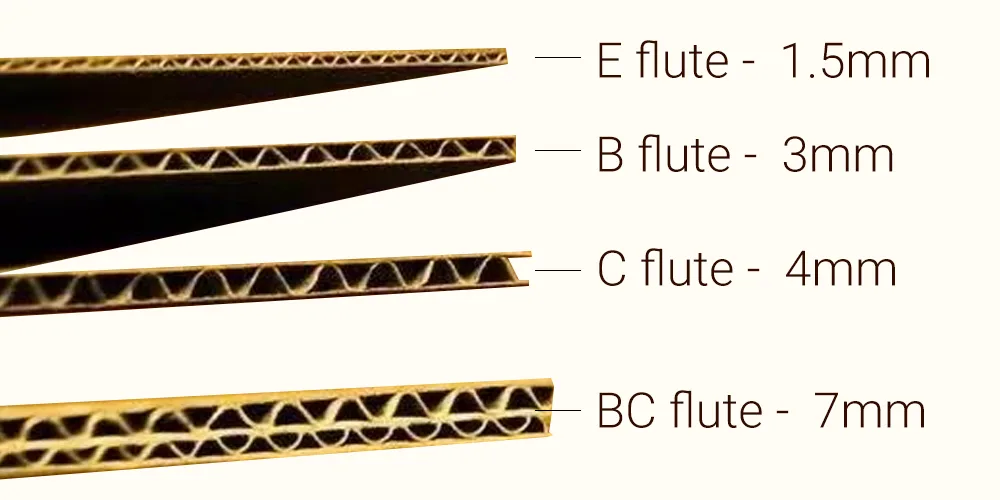
E flute produces the smoothest print surface and the thinnest profile, making it the preferred choice for retail-facing corrugated packaging. B and C flutes prioritize structural protection over print quality. BC double-wall combines both for the highest crush resistance at the cost of added thickness and weight.
Common Applications
- Shipping boxes: standard brown or white corrugated cartons for e-commerce, wholesale distribution, and fulfillment.
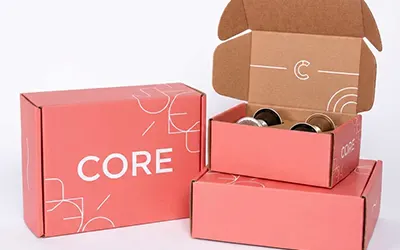
- Mailer boxes: printed corrugated mailers for subscription boxes, direct-to-consumer brands, Kickstarter fulfillment, and promotional kits.
- Display packaging: point-of-sale counter displays, floor-standing displays, and shelf-ready packaging for retail environments.
- Product packaging: corrugated boxes with custom die-cut inserts for electronics, food, cosmetics, candles, and fragile items.
- Master cartons: outer shipping cartons that hold multiple units of folding cartons, rigid boxes, or other packaged products during transit.
- Game box shipping: corrugated outer boxes protect board game boxes and card deck tuck boxes during transport to distributors and backers.
Printing on Corrugated Board
Corrugated board can be printed using several methods. The choice depends on the visual quality required, the flute type, and the production volume.
Offset lamination: full-color CMYK artwork is printed on a separate paper sheet using offset lithography, then the printed sheet is laminated onto the corrugated board. This produces the highest print quality—photographic images, fine typography, and rich color—and is the standard method for retail-facing mailer boxes, display packaging, and branded shipping boxes.
Screen printing: ink is transferred directly onto the corrugated surface through flexible plates. This is the most common and cost-effective method for shipping boxes, typically in one to three spot colors. Print quality is functional rather than photographic—suitable for logos, text, handling marks, and simple graphics.
E-flute and B-flute corrugated board, with its thin and smooth profile, produces the best results for both direct offset lamination and screen printing. Thicker C flute can show a slight washboard effect on laminated surfaces, though this is minimized with proper production technique. For any corrugated box with full-color printed graphics on the outside, the process is always the same: the artwork is first printed on a sheet of 250 gsm white cardstock, then film-laminated for protection, and finally mounted onto the corrugated board.
Finishing Options
- Lamination: gloss or matte film lamination for scuff resistance and visual appeal on retail-facing surfaces.
- Varnish and UV coating: gloss, matte, or spot UV for selective highlights and surface protection.
- Foil stamping: available on laminated corrugated surfaces for premium branding accents such as logos and product names.
- Die-cutting: custom shapes, windows, handles, locking tabs, and insert dividers.
- Embossing and debossing: possible on laminated corrugated surfaces for tactile branding elements.
Corrugated Board vs. Solid Grayboard
Corrugated board and grayboard serve different purposes. Corrugated board is engineered for shipping protection—it is lightweight, shock-absorbent, and stackable. Grayboard is engineered for structural rigidity in finished products like hardcover book cases and rigid boxes, where the board itself becomes part of the product the customer holds.
In many packaging projects, both materials work together: a rigid box made from grayboard is packed inside a corrugated shipping carton for safe transit. The grayboard provides the premium feel; the corrugated board provides the transit protection.
Frequently Asked Questions
Which flute should I choose for my project?
For retail packaging that customers will see and handle (mailer boxes, display boxes, branded product boxes), use E flute with offset lamination for the best print quality and a clean, thin profile. For shipping and transit protection, use B or C flute. For heavy or fragile products, use BC double-wall.
Can I print full-color photographic images on corrugated board?
Yes, using offset lamination. The artwork is printed on a separate sheet and laminated onto the corrugated surface. This produces the same print quality as a folding carton. Direct screen printing on corrugated is limited to spot colors and simpler graphics.
Is corrugated board recyclable?
Yes. Corrugated board is one of the most widely recycled packaging materials. It is accepted in standard paper recycling streams in virtually all markets.
Can I get custom die-cut shapes?
Yes. We produce custom dies for any box shape, including windows, handles, tuck flaps, auto-lock bottoms, and partition inserts.
Related Resources