
 Book Printing in China
 Custom Card Decks
 Custom Holographic Cards
 Free Wall Calendar Template
 Free Desk Calendar Template
 Folding Cartons
 Rigid Boxes
 Corrugated Boxes
 Custom Board Game
 Custom Card Game
 Kickstarter Print Solutions
Sheet-Fed vs Web Offset Printing
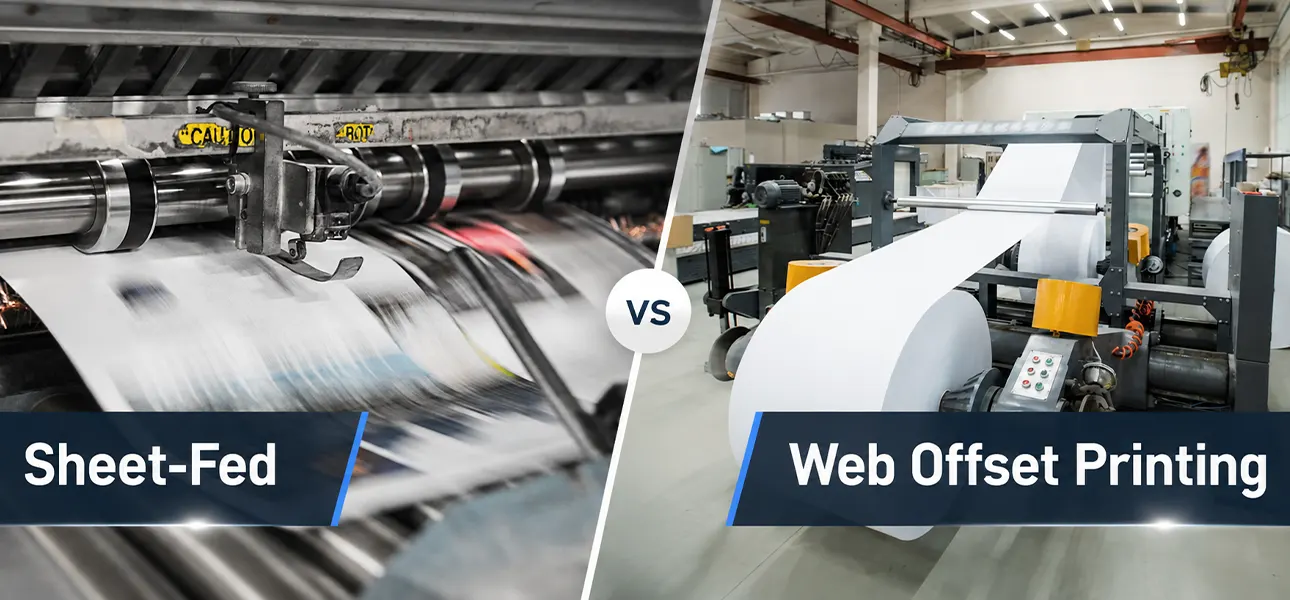
Sheet-fed and web offset are the two main types of offset press. A sheet-fed press prints onto individual pre-cut sheets of paper and is built for high quality and flexibility. A web offset press prints onto a continuous roll, or web, of paper at very high speed and is built for very large runs. Both use the same plate-to-blanket-to-paper offset principle; they differ in how paper is fed, the run sizes they suit, and the work they do best.
If you are deciding how your book, card deck, packaging, or magazine should be produced, the sheet-fed versus web choice shapes quality, run size, and cost. This guide explains how each press works, where each one shines, and which one we use for premium custom work at QinPrinting.
How Sheet-Fed Offset Works
A sheet-fed offset press takes in paper one sheet at a time. A feeder lifts each pre-cut sheet, registers it precisely, and carries it through the printing units, where the plate-to-blanket-to-paper transfer lays down each color. The printed sheet then moves to the delivery stack to dry before finishing.
Because each sheet is handled individually and registered on its own, sheet-fed presses give operators fine control over color, registration, and ink density. They run a wide range of paper weights and stocks, from lightweight text papers up to heavy boards, and they pair naturally with premium finishing such as foil stamping, spot UV, embossing, and special inks. That control and flexibility is exactly why sheet-fed is the standard for books, card decks, packaging, board games, and art printing, where the look and feel of each piece matters.
How Web Offset Works
A web offset press prints onto a single continuous roll of paper that unwinds and runs through the press at high speed. Instead of stopping for each sheet, the paper flows through the printing units in an uninterrupted ribbon, and at the end of the line the press cuts and folds it into finished sections in one pass. This is what allows web presses to reach speeds and volumes that sheet-fed machines cannot match.
That speed only pays off across enormous runs. Threading the roll and bringing the press up to stable color, known as makeready, consumes a lot of paper and time, so the setup is justified only when it is spread over a very large quantity. As a rule of thumb, web offset is not a sensible choice below the 30,000 to 50,000 copy range. Under that, the per-copy economics fall apart and sheet-fed is the better option.
Web offset is also far more limited in materials. A press is set up around a specific roll and runs only a narrow band of paper weights, typically light text stock around 100 gsm or below. It cannot handle heavy or specialty stocks, and the printed web usually comes off the press already folded into sections, with little room for the finishing that sheet-fed allows. In practice, this means web is suited to book interior pages only, not covers; the cover is still printed sheet-fed on heavier stock and bound afterward.
Historically, web offset was everywhere. A decade or two ago, the bulk of newspapers, direct-mail flyers, and high-circulation magazines were printed this way, because those products needed millions of copies on light paper with no special finishing. That is exactly the profile web offset excels at. Today, with the growth of digital printing and shorter, more varied print runs, far fewer jobs reach the volume that web requires, and most orders are no longer printed on web presses at all.
Coldset and Heatset Web Offset
Web offset comes in two forms, defined by how the ink is dried. Coldset web offset has no dryer; the ink dries by absorbing into the paper. It is fast and inexpensive but suited to uncoated, absorbent stock, which is why it is used for newspapers and low-cost paperback interiors. Heatset web offset passes the printed web through a hot-air dryer that sets the ink, allowing it to print on coated papers with brighter color and a glossier result. Heatset is the choice for glossy magazines, catalogs, and advertising work where appearance matters more.
Sheet-Fed vs Web Offset at a Glance
The table below sums up the practical differences that affect your decision.
| Factor | Sheet-Fed Offset | Web Offset |
|---|---|---|
| Paper supply | Individual pre-cut sheets | Continuous roll (web) |
| Best run size | A few hundred up to large runs | Very large runs only (around 30,000 to 50,000+) |
| Speed | Moderate | Very high |
| Print quality | Highest; fine color and registration control | High on heatset; lower on coldset |
| Paper and stock range | Widest, including heavy boards and specialty stocks | Narrow; light text stock, often 100 gsm or below |
| Finishing flexibility | Excellent; foil, spot UV, embossing, special inks | Minimal; usually folded inline, little post-press |
| Typical products | Books, card decks, packaging, board games, art prints | Newspapers, magazines, large catalogs, book interiors |
The Sheet-Fed Advantage: Quality, Materials, and Finishing
For premium work, sheet-fed has a built-in edge, and it rests on three strengths: print quality, material choice, and finishing.
Print quality. Handling paper one sheet at a time lets the press hold tight registration and steady ink density across the whole run, so color stays even and detail stays sharp from the first copy to the last. This per-sheet control is the core reason sheet-fed output looks cleaner than high-speed web work.
Material choice. Sheet-fed presses accept a wide range of stocks, from light text papers up to heavy boards, plus coated, uncoated, textured, kraft, colored, and specialty surfaces. You are free to choose the paper that suits the product rather than being confined to a single roll weight.
Finishing after printing. Because the work arrives as flat printed sheets, it can move on to a full range of post-press processes such as foil stamping, spot UV, embossing, debossing, die-cutting, painted edges, lamination, and varied binding. These are the steps that make a finished piece feel premium, and they integrate naturally with sheet-fed production.
Web presses are engineered for throughput rather than this kind of refinement. On coldset machines especially, the absorbent light stock and high speed favor volume over crispness, and the web typically comes off already folded with little finishing applied. Heatset web closes some of the gap for coated magazine work, but for books, card decks, packaging, and board games that need precise color, varied materials, and rich finishing, sheet-fed remains the better match.
Which One Is Right for Your Project?
A simple way to decide: think about your quantity, your quality bar, and your paper and finishing.
- Choose sheet-fed if you want the best quality, are printing on quality, heavy, or specialty stock, want finishing such as foil, spot UV, or embossing, or are running anything from a few hundred up to a large quantity. Card decks, board games, and packaging boxes must be printed sheet-fed; their heavier stocks and finishing simply cannot run on a web press.
- Choose web only for an extremely high volume of a simple product on light paper, on the order of 30,000 to 50,000 copies and up, such as a newspaper, a mass-circulation magazine, or a very large catalog, where raw speed and per-copy cost outweigh material choice and finishing.
Books can sit in both camps, but usually in a split. Even when a very large book run has its interior pages printed on web, that only works for thin text stock around 100 gsm or lighter, and the cover is still printed sheet-fed on heavier stock and bound afterward. For nearly all creators, brands, and publishers, the work falls squarely in sheet-fed territory; web becomes relevant only at the very high volumes and simple specifications typical of periodical publishing.
What We Use at QinPrinting
We run sheet-fed offset presses from Heidelberg and Komori in four-color, five-color, and eight-color configurations, because sheet-fed is the right fit for the high-quality books, card decks, packaging, and board games we specialize in. Card decks, board games, and packaging boxes are printed sheet-fed without exception, since their heavier stocks and finishing cannot be produced on web. Sheet-fed gives us the registration control, the broad paper and board range, and the integrated finishing our clients’ projects call for, and we keep color consistent from proof to press with GMG Color Proof software. If your project is a book, a deck, a box, or a game, sheet-fed offset is almost certainly what it should be printed on, and it is what we do.
Frequently Asked Questions
What is the minimum quantity for web offset printing?
Web offset only makes economic sense at very high volumes, generally in the range of 30,000 to 50,000 copies and above, and only on light stock around 100 gsm or below. Below that quantity, the long makeready and roll setup outweigh the speed advantage, and sheet-fed offset is the more practical and cost-effective choice.
Is sheet-fed or web offset better quality?
Sheet-fed generally produces higher quality. Handling sheets individually gives finer control over registration and ink density, supports heavier and specialty stocks, and integrates premium finishing. Web offset is built for speed and very high volumes rather than per-piece refinement, though heatset web does produce good results on coated magazine work.
What is the difference between coldset and heatset web offset?
Both are web offset, distinguished by drying. Coldset has no dryer and lets ink absorb into uncoated paper, which suits newspapers. Heatset uses a hot-air dryer to set ink on coated papers, giving brighter, glossier results for magazines and catalogs.
Which uses a roll of paper, sheet-fed or web?
Web offset uses a continuous roll, called a web, of paper. Sheet-fed offset uses individual pre-cut sheets. That difference in paper supply is the core distinction between the two press families.
Do you print on sheet-fed or web presses?
We print on sheet-fed offset presses. Sheet-fed is the best fit for the high-quality books, card decks, packaging, and board games we produce, because it offers superior color control, a wide stock range, and full finishing flexibility.
Is web offset cheaper than sheet-fed?
Web offset can be cheaper per copy, but only at very high volumes that justify its long makeready and roll setup. For the run sizes and quality most book, card, and packaging projects need, sheet-fed is the more practical and economical choice.