
 Book Printing in China
 Custom Card Decks
 Custom Holographic Cards
 Free Wall Calendar Template
 Free Desk Calendar Template
 Folding Cartons
 Rigid Boxes
 Corrugated Boxes
 Custom Board Game
 Custom Card Game
 Kickstarter Print Solutions
Standard Offset vs Offset UV Printing
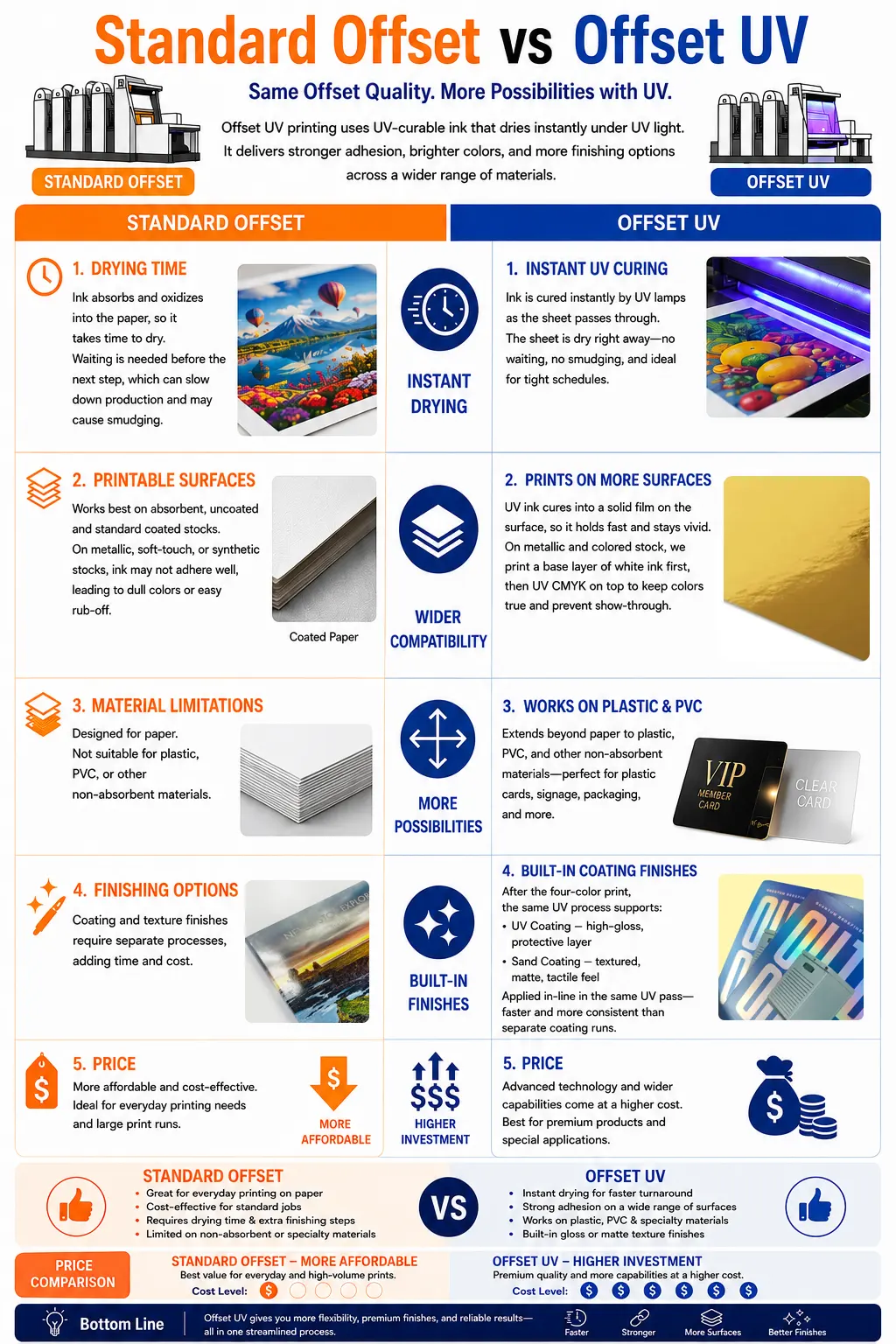
Standard offset and offset UV are two distinct printing methods that run on different presses. Both build a four-color CMYK image from a plate, but they use different machines and different inks. Standard offset presses use conventional inks that dry by soaking into the paper and evaporating, which works beautifully on ordinary coated and uncoated stock. Offset UV presses are fitted with UV lamps and run ultraviolet-curable CMYK inks that stay liquid until they pass under the lamps, where they cure to a solid film in an instant. That difference unlocks something standard offset cannot do: clean, reliable printing on metallic card, soft-touch stock, colored paper, plastic, and PVC, surfaces where conventional ink struggles to adhere. On those tinted or metallic stocks, we often lay down a layer of white ink first and then print the UV CMYK inks on top, so photos and design colors reproduce accurately rather than being skewed by the base color of the stock. This guide explains when each one is the right call for your project.
Quick answer:
Choose standard offset for ordinary paper and board projects such as books, catalogs, and most card decks, where it gives you the best price. Choose offset UV when you are printing on metallic gold or silver card, soft-touch stock, colored or specialty papers, plastic, or PVC, or when you want the option of a UV coating or sand coating finish over your four-color print.
Standard Offset vs Offset UV: Side-by-Side
Each runs on its own type of press, so the comparison comes down to ink behavior, the materials each can print, and the finishes each makes possible.
| Factor | Standard Offset Printing | Offset UV Printing |
|---|---|---|
| Ink type | Conventional ink, dries by absorption and evaporation | UV-curable ink, cures instantly under UV light |
| Drying | Needs time to set; sheets may sit before finishing | Cures the moment it leaves the lamps; ready to handle at once |
| Standard paper | Excellent on coated and uncoated stock | Prints well, with the same crisp result |
| Specialty stock | Limited; ink can sit on the surface or rub off | Adheres cleanly to metallic, soft-touch, colored, and coated specialty papers |
| Non-paper materials | Not suitable | Prints on plastic, PVC, and similar non-absorbent surfaces |
| Finishing options | Standard, often paired with lamination | Supports UV coating and sand (textured) coating after the four-color print |
| Cost | Lower per unit on ordinary stock | Higher; premium inks and process |
| Best for | Books, catalogs, standard card decks, folding cartons | Specialty card stocks, plastic cards, premium packaging, decorative finishes |
What Makes Offset UV Different
Everything that sets offset UV apart comes from the ink. Because UV ink cures rather than soaks in, it behaves in ways conventional ink cannot.
- Instant UV curing. the sheet is dry the instant it passes the UV lamps. There is no waiting for ink to set before the next step, which keeps tight schedules moving and prevents smudging on slow-drying stocks.
- Prints on surfaces ordinary ink cannot. conventional ink relies on the paper absorbing it. On metallic gold and silver card, soft-touch stock, heavily coated specialty papers, and colored papers, that absorption does not happen well, so standard ink can rub off or look weak. UV ink cures into a solid film on the surface, so it holds fast and stays vivid. On metallic and colored stock we also print a base layer of white ink before the UV CMYK inks, which prevents the stock’s own color from tinting the artwork and keeps photos and brand colors true.
- Works on plastic and PVC. offset UV extends beyond paper to plastic, PVC, and other non-absorbent materials, opening up products such as plastic cards and specialty packaging that standard offset cannot produce.
- Built-in coating finishes. after the four-color print, the same UV process supports a UV coating for a high-gloss protective layer, or a sand coating for a textured, matte, tactile feel. These finishes are applied as part of the offset UV workflow rather than a separate run.
What Standard Offset Does Best
For the everyday paper work that makes up most print orders, conventional offset is still the practical, economical choice.
- Most economical on regular stock. on ordinary coated and uncoated paper, standard offset gives the lowest per-unit price once the plates are set. For books and high-volume paper runs, nothing beats it on cost.
- Proven for paper products. books, novels, cookbooks, catalogs, magazines, and standard card decks are all printed on absorbent paper that conventional ink suits perfectly.
- Accurate, repeatable color. standard offset reproduces fine type, smooth gradients, and accurate Pantone spot colors with reliable consistency across long runs and repeat orders.
Choose standard offset when:
- You are printing on ordinary coated or uncoated paper and board.
- Your project is a book, catalog, magazine, or a standard card deck.
- Per-unit cost is your main concern on a high-volume run.
Choose offset UV when:
- Your stock is metallic gold or silver card, soft-touch, colored, or another specialty paper that resists conventional ink.
- You are printing on plastic, PVC, or another non-absorbent material.
- You want a UV coating for high gloss and protection, or a sand coating for a textured tactile finish.
- You need the sheet dry and ready to finish immediately.
Coatings After the Four-Color Print
One of the strengths of offset UV is what happens after the colors are down. Once the four-color image is printed, you can add a UV coating that cures to a hard, high-gloss layer, giving the piece a striking shine and a tough, scratch-resistant surface. As an alternative finish, a sand coating produces a fine, matte, grainy texture that feels distinctive in the hand and reads as premium on packaging and covers.
Both coatings can run as a flood layer across the whole sheet or as a spot layer over chosen areas, so you can make a title, a logo, or an illustration stand out against the rest of the design. The contrast between a coated highlight and the surrounding stock is what gives many premium card decks and boxes their tactile, eye-catching quality.
How QinPrinting Handles Offset and Offset UV
We run an offset facility in Shanghai, with both standard offset and offset UV presses under one roof. The material you choose decides the route. For metallic, soft-touch, colored, plastic, or PVC stock, we print on our offset UV machines so the ink cures cleanly on the surface and holds its color. For regular paper and card stock, we use standard offset for the sharpest result at the best price. Book runs start at 100 copies, card decks at 200, and custom boxes at 300, so you can access either process without committing to enormous quantities.
Whichever route fits your project, you work with one team from quote to delivery. Sea freight to most destinations runs about 5 to 7 weeks door to door, with faster air options for urgent timelines.
Frequently Asked Questions
What is the difference between standard offset and offset UV printing?
Standard offset and offset UV run on different presses with different inks. Standard offset presses use conventional ink that dries by soaking into the paper, which suits ordinary coated and uncoated stock. Offset UV presses are fitted with UV lamps and use UV-curable ink that cures instantly under ultraviolet light, so they can print on metallic, soft-touch, colored, and other specialty papers, as well as plastic and PVC, where conventional ink does not adhere well.
Why can offset UV print on metallic and specialty card when standard offset cannot?
Conventional ink needs the paper to absorb it. Metallic gold and silver card, soft-touch stock, heavily coated specialty papers, and colored papers absorb little ink, so standard ink can sit on the surface and rub off. UV ink cures into a solid film on the surface instead of relying on absorption, so it bonds firmly and stays vivid on those stocks. Because offset UV prints in CMYK just like standard offset, we often add a white ink underprint on metallic or colored stock first, so the four colors reproduce accurately on top instead of being shifted by the stock’s base color.
Can offset UV print on plastic and PVC?
Yes. Because UV ink cures on the surface rather than soaking in, offset UV prints cleanly on plastic, PVC, and other non-absorbent materials. This is one of the main reasons to choose offset UV over standard offset for products such as plastic cards and certain specialty packaging.
What is the difference between UV coating and sand coating?
Both are finishes applied after the four-color print in the offset UV workflow. UV coating cures to a hard, high-gloss layer that adds shine and scratch resistance. Sand coating produces a fine, matte, grainy texture with a distinctive tactile feel. Either can run as a full flood layer or as a spot layer over chosen areas.
Is offset UV more expensive than standard offset?
Generally yes. UV-curable inks and the UV curing and coating process add cost, and offset UV is positioned as a premium option. For an ordinary high-volume paper run, standard offset gives the lower per-unit price. The extra cost of offset UV is justified when your stock or finish requires it.
Get the Right Process for Your Project
Not sure whether your project needs standard offset, offset UV, or a special coating? Send us your specs and the stock you have in mind. We will recommend the most cost-effective approach and put a detailed quote in your hands within 24 hours. File review is free and there is no commitment.
Related Guides
Still deciding how to print your project? These guides go deeper:
- Compare offset and digital: Offset Printing vs Digital Printing — cost curves, quality, and the break-even point.
- See the full picture: Offset Printing Services — our full offset capabilities, equipment, and quote options.
- Browse products: Book Printing, Card Deck Printing, and Packaging Boxes — the products we print most with offset.
- Sheet-fed and web offset