
 Book Printing in China
 Custom Card Decks
 Custom Holographic Cards
 Free Wall Calendar Template
 Free Desk Calendar Template
 Folding Cartons
 Rigid Boxes
 Corrugated Boxes
 Custom Board Game
 Custom Card Game
 Kickstarter Print Solutions
What Is Offset Printing?
Offset printing is a commercial printing method that transfers an inked image from a thin aluminum plate to a rubber blanket, and then from the blanket onto paper. Because the image is off set onto an intermediate surface before it touches the paper, the process is also called offset lithography. It produces crisp, consistent results across long print runs.
That single indirect step, plate to blanket to paper, is the whole idea behind the name and the reason offset printing has been the backbone of books, magazines, packaging, and card decks for more than a century. This guide breaks down how it works, traces where it came from, and explains the parts of a modern press, so you can see exactly what happens between your finished file and the printed product in your hands.
The Basic Idea Behind Offset Printing
Offset printing is built on a simple chemical fact: oil and water do not mix. Every offset plate carries your image as a pattern of areas that attract grease-based ink and areas that attract water and repel ink. When the plate is rolled with water and then ink, ink sticks only to the image areas. The plate never touches the paper directly. Instead, it presses against a rubber blanket, the blanket picks up the inked image, and the blanket lays that image onto the paper.
This is what separates offset from older methods like letterpress, where a raised, inked surface stamps straight onto the page. The rubber blanket flexes to meet the paper, so it can print evenly on smooth, textured, and uncoated stocks alike, and it protects the delicate plate from wear. The result is sharp detail, even ink coverage, and color that stays consistent from the first sheet to the last.
How Offset Printing Works, Step by Step
A print job moves through a clear sequence, from your file to the finished sheet. Here is what happens at each stage.
- Prepress and platemaking. Your artwork is separated into the printing colors, usually cyan, magenta, yellow, and black, plus any spot colors. Each color gets its own thin aluminum plate, produced on a computer-to-plate (CTP) device that images your file directly onto the plate with a laser. One plate is made for every color in the job.
- As the press runs, each plate is first coated with a thin film of water, called the dampening or fountain solution. The water clings to the non-image areas of the plate.
- The plate then passes under ink rollers. Because the inked image areas repel water and the wet non-image areas repel ink, ink transfers only to the parts that carry your image.
- Offset to the blanket. The inked plate rolls against the rubber blanket cylinder. The image transfers onto the blanket, reversed left to right. This is the offset step that gives the process its name.
- Transfer to paper. Paper passes between the blanket cylinder and a solid impression cylinder. The blanket presses the inked image onto the paper, flipping it back to its correct orientation.
- Repeat per color. A full-color press repeats this for each color in turn, laying down cyan, magenta, yellow, and black, and any spot colors, in precise registration so they combine into the final image.
- Drying and finishing. The printed sheets dry, then move on to cutting, folding, binding, and any finishing such as lamination or foil. At that point the printed sheets become a book, a deck, a box, or whatever the project calls for.
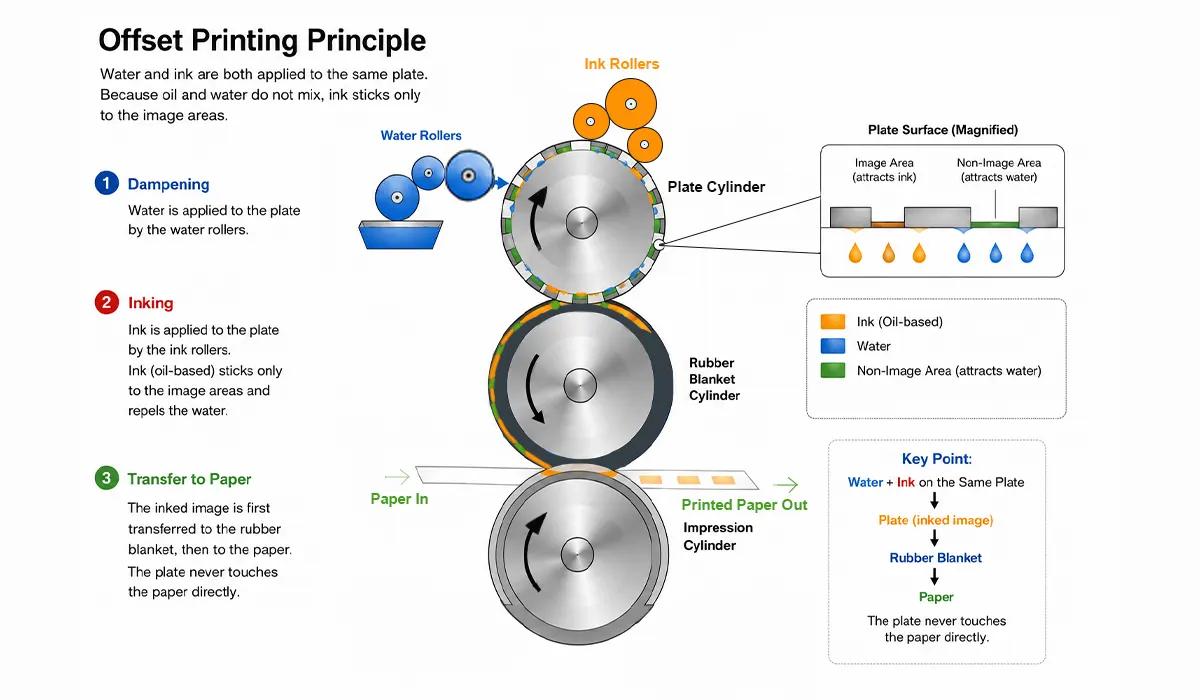
The key takeaway is the order: plate to blanket to paper, one color at a time. Once a press is set up and running, it prints these sheets at high speed with very little variation, which is why offset is the method of choice when quality and consistency matter across a large quantity.
A Short History of Offset Printing
Offset grew out of lithography, a printing method invented by Alois Senefelder in 1796. Early lithography printed from a flat, treated stone using the same oil-and-water principle that offset still relies on today. It was a major step away from raised-type letterpress, but the image was still printed directly onto the paper.
The offset breakthrough came at the turn of the twentieth century. In 1875 Robert Barclay developed an offset press for printing on tin, using an intermediate cylinder to carry the image. Then, around 1903 to 1904, the American printer Ira Washington Rubel and, separately, the Harris brothers discovered that adding a rubber blanket between plate and paper produced noticeably sharper, cleaner prints on paper. That rubber blanket is the innovation that defines offset printing and is still at the heart of every offset press.
Through the twentieth century, offset steadily replaced letterpress as the dominant commercial method. Photographic platemaking, then digital prepress and computer-to-plate systems, removed slow manual steps and improved accuracy. Today offset remains the standard for high-volume, high-quality work, while digital printing has grown alongside it to serve short runs and personalized jobs.
The Parts of a Modern Offset Press
Most of the action in offset printing happens across three cylinders working together, supported by the ink and dampening systems. Understanding these parts makes the process easy to picture.
| Part | What it does |
|---|---|
| Plate cylinder | Holds the metal plate that carries your imaged design for one color. It receives water, then ink, then passes the inked image to the blanket. |
| Blanket cylinder | Wrapped in the rubber blanket that picks up the image from the plate and offsets it onto the paper. The blanket's flexibility is what lets offset print cleanly on many paper types. |
| Impression cylinder | Presses the paper firmly against the blanket so the image transfers evenly. It supplies the controlled pressure that seats the ink onto the sheet. |
| Dampening system | Rollers that apply the thin water film to the non-image areas of the plate before inking. |
| Inking system | A train of rollers that delivers an even layer of ink to the image areas of the plate, one unit per color. |
| Delivery and dryer | Carries printed sheets out of the press and dries the ink before finishing. |
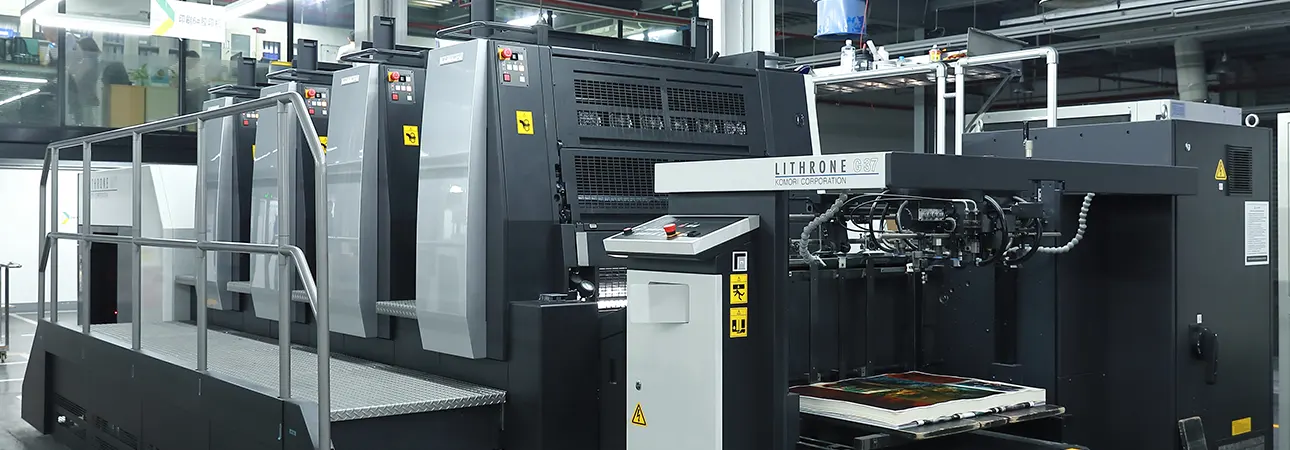
A press that prints only black has a single set of these units. A full-color press has one complete unit per color, lined up so each sheet passes through cyan, magenta, yellow, and black in sequence. Presses are commonly built as four-color, five-color, or eight-color machines, with the extra units used for spot colors, varnishes, or special inks.
At QinPrinting, we run Heidelberg and Komori sheet-fed offset presses in four-color, six-color, and eight-color configurations, with GMG Color Proof software keeping color consistent from proof to press.
Sheet-Fed and Web Offset
Offset presses come in two broad families. Sheet-fed presses print onto individual pre-cut sheets of paper and are prized for high quality and flexibility, which makes them ideal for books, card decks, packaging, and art printing. Web offset presses print onto a continuous roll of paper at very high speed, which suits enormous runs such as newspapers, magazines, and catalogs.
The two differ in how paper is fed, the run sizes they suit, and the finishing they allow. We cover that comparison in full on a dedicated page; for most premium book, card, and packaging work, sheet-fed offset is the right choice, and it is what we use.
What Offset Printing Is Used For
Offset is the workhorse behind most of the printed products you handle every day. It is especially well suited to projects where image quality, color accuracy, and a sizeable quantity all matter at once.
- Books of every kind, from paperbacks and hardcovers to children’s board books, art books, and coffee table editions.
- Card decks such as tarot, oracle, playing, flash, and trading cards, where consistent color across a full deck is essential.
- Packaging, including folding cartons, rigid boxes, and retail boxes that need precise brand color.
- Board games and their components, boxes, boards, tiles, and cards.
- Marketing and publishing materials such as catalogs, magazines, brochures, calendars, and posters.
The common thread is volume with quality. Offset’s setup cost is spread across the run, so the more copies you print, the lower the cost per copy, while the quality stays uniform throughout.
Why Offset Is Still the Standard
Decades after digital printing arrived, offset remains the first choice for serious print runs for a few durable reasons. It delivers sharper detail and richer, more accurate color, especially with Pantone spot colors and metallic or fluorescent inks. It prints beautifully on the widest range of papers and stocks, including textured and specialty sheets that trip up other methods. And it gets cheaper per unit as the quantity rises, so it scales with your project.
Offset is not the answer for every job. For a handful of copies, a quick prototype, or work that changes from one copy to the next, digital printing is usually faster and more economical because it has no plate setup. Knowing where that line falls is the practical question most people are really asking, and we walk through it in detail on the pages linked below.
Frequently Asked Questions
Why is it called offset printing?
Because the inked image is not printed straight from the plate onto the paper. It is first transferred, or offset, onto a rubber blanket, and the blanket then prints it onto the paper. That intermediate step is what the word offset refers to.
Is offset printing the same as lithography?
They are closely related. Lithography is the underlying technique, printing from a flat plate using the fact that oil and water repel each other. Offset printing is lithography with an added rubber blanket between the plate and the paper, which is why it is often called offset lithography.
What is the difference between offset and digital printing?
Offset prints from physical plates through a rubber blanket and needs a setup step, which makes it cheaper per copy at higher quantities and excellent for color accuracy. Digital prints directly from a file with no plates, which is faster and more economical for very short runs and personalized jobs. We compare the two in full on our offset vs digital printing page.
Does offset printing use CMYK?
Yes. Most full-color offset work is built from four process colors: cyan, magenta, yellow, and black (CMYK), each printed from its own plate. Spot colors such as Pantone inks, metallics, and fluorescents can be added on separate units for exact brand matching or special effects.
Is offset printing good for small quantities?
Not usually. The plate and setup costs make offset less economical for very small runs. For a few copies or a quick proof, digital printing is normally the better fit. Offset becomes the more cost-effective choice as your quantity grows.
Related Resources
- Offset Printing Services overview — our full breakdown of what offset printing covers and which projects we handle
- Offset Printing Cost Guide — detailed cost factors, sample pricing, and how to budget your project (publish later in cluster series)
- What Is Offset Printing? — how offset printing works, step by step (publish later in cluster series)
- Print-On-Demand vs Offset for Self-Published Authors — if you’re an indie author weighing KDP/IngramSpark against bulk offset, this comparison covers the publishing-specific angle
- Book Printing Services — our main book printing product page