
 Book Printing in China
 Custom Card Decks
 Custom Holographic Cards
 Free Wall Calendar Template
 Free Desk Calendar Template
 Folding Cartons
 Rigid Boxes
 Corrugated Boxes
 Custom Board Game
 Custom Card Game
 Kickstarter Print Solutions
Offset Printing vs Digital Printing
If you’re planning a print project — a book, a card deck, packaging, a catalog — one of the first technical decisions you’ll face is whether to print offset or digital. The choice affects your cost per unit, your color accuracy, your paper options, and your delivery timeline. It also affects how many copies you should order in the first place.
This guide breaks down the real differences between offset printing and digital printing — not just the textbook definitions, but the practical break-even points, quality trade-offs, and project types where each method wins. By the end, you’ll know exactly which method fits your project and roughly how many copies you’d need to print before offset becomes the smarter financial choice.
At QinPrinting, we run our own offset facility in Shanghai and have produced offset printing projects and digital printing samples for clients in publishing, board games, and consumer brands for over a decade. The recommendations below come from real production experience, not generic SEO copy.
The Short Answer
Use digital printing when you need fewer than 100 copies and regular size and regular paper, fast turnaround (under 7 days), or print-on-demand fulfillment.
Use offset printing when you need 100+ copies and custom size, custom paper and Smyth sewn binding, exact color matching (Pantone or branded color), premium paper or finishes (foil, embossing, spot UV), or large-format pages.
The break-even point — where offset becomes cheaper per copy than digital — typically falls around 100 copies for most book projects, and around 200 copies for card decks. We’ll explain why below.
Offset vs Digital Printing: At-a-Glance Comparison
Before we dig into the details, here’s the complete side-by-side comparison covering every factor that typically affects a print buyer’s decision:
| Factor | Offset Printing | Digital Printing |
|---|---|---|
| Minimum Order | 100 copies (books) / 200 decks (cards) | 1 copy |
| Cost Per Copy at Low Volume | High — setup costs spread across few units | Low — no setup, flat per-copy rate |
| Cost Per Copy at High Volume | Very low — setup absorbed, plate runs cheap | Stays the same — no volume discount |
| Break-Even Point | Wins above ~100 copies | Wins below ~100 copies |
| Color Accuracy | Excellent — exact Pantone matching, premixed inks | Good — CMYK toner, slight variation possible |
| Color Consistency Across Run | Excellent — copy #1 matches copy #10,000 | Good — minor drift possible on very long runs |
| Paper Options | Wide — heavy stocks (350+ gsm), uncoated, textured, specialty | Limited — typically 80–250 gsm coated and uncoated |
| Sheet Size | Up to 40 inches | Up to 29 inches (typically 19) |
| Specialty Finishes | Foil stamping, embossing, spot UV, die-cut, gilded edges | Most specialty finishes not supported |
| Turnaround Time | Longer — 1–2 weeks for paperback; 2-3 weeks for hardcover production (setup + run) | Faster — 3–7 days for short-run paperback jobs |
| Reprint Speed | Slower — plates archived but need re-setup | Instant — same file, same machine |
| Best For | Trade-quality books, premium cards, packaging, branded materials | Proofs, samples, POD, very short runs, personalized prints |
Now let’s dig into the factors that drive the actual decision for most print buyers — starting with the one that matters most.
1. The Cost Difference: Why 100 Copies Is the Magic Number
Cost is the number-one reason people choose between offset and digital printing. Here’s how the two cost structures actually work.
Offset printing cost structure
Offset printing has two cost components: a fixed setup cost and a per-copy run cost.
- Setup cost: Includes plate-making (one metal plate per color, so typically 4 plates for full-color CMYK printing, plus extra for any Pantone spot colors), ink mixing, press calibration, and paper loading. This setup cost is the same whether you print 100 copies or 10,000 — and it’s substantial.
- Per-copy run cost: Once the press is set up and running, each additional copy costs very little — just paper and ink. Offset presses produce thousands of copies per hour, so the per-copy run cost is the lowest in the printing industry.
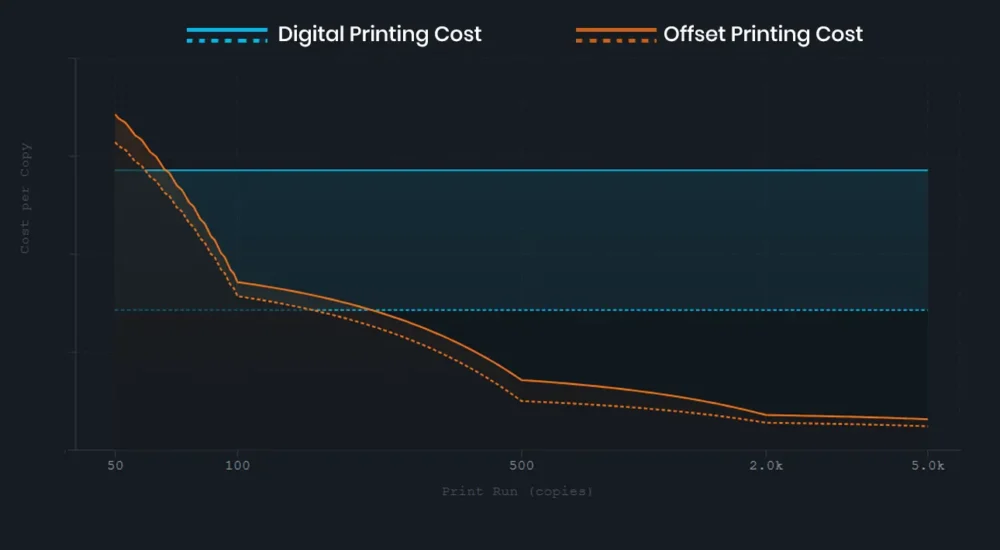
The result: offset is expensive at low volumes (because setup costs are spread over few copies) and very cheap at high volumes (because setup is a small fraction of total cost).
Digital printing cost structure
Digital printing has effectively no setup cost. You send the file, the press calibrates automatically, and printing begins. Each copy costs roughly the same as the last — there’s no economy of scale.
The result: digital is cheap for 1 copy and stays at roughly the same per-copy cost whether you print 10 or 10,000. There’s no volume discount because there’s no setup to amortize.
Where the lines cross
For most book projects in standard formats, the break-even point falls around 100 copies. Below 100 copies, digital is cheaper per copy. Above 100 copies, offset wins — and the gap grows wider with every additional copy. At 2,000 copies, offset is typically 40–50% cheaper per copy than digital. At 5,000+ copies, the difference can exceed 60%.
For card decks, the break-even is lower — often around 200 decks — because card decks use heavier stocks and finishing options that digital handles poorly anyway.
For a full breakdown of what drives offset printing costs — plates, paper, finishes, and freight — see our offset printing cost guide.
2. Quality Comparison: Where Each Method Wins
The old assumption that “offset is higher quality” is partly true and partly outdated. Modern digital presses produce excellent quality for many applications. But there are specific areas where offset still has a meaningful advantage — and others where digital is genuinely comparable.
Color accuracy
Offset prints with premixed inks. If your brand uses Pantone 286 C, an offset press loads ink that is literally Pantone 286 C. The color on paper matches your brand standard with very high accuracy, and that accuracy holds across the entire print run.
Digital prints with CMYK toner — four colors blended in microscopic dot patterns to simulate other colors. For most everyday work, the result looks excellent. But for brand-critical colors, Pantone matching is approximate, not exact. A digitally printed deep red may shift slightly toward orange or magenta depending on the press and paper.
For art books, photography books, packaging with branded colors, or any project where color fidelity matters, offset is the safer choice.
Color consistency across the run
On an offset press, copy #1 and copy #10,000 are essentially identical. The ink, plates, and pressure don’t drift over the course of a run.
On a digital press, very long runs can show slight color drift as toner cartridges age or temperatures shift. For runs under 500 copies this is invisible. For runs of 2,000+, an offset press will deliver more uniform results.
Detail and resolution
Offset prints with sharper edges on text and fine line work — particularly important for small fonts, technical diagrams, and detailed illustration. Digital is very good but slightly less sharp on close inspection.
For full-color photography reproduction, modern digital presses are competitive with offset at small sizes. At large sizes or on textured paper, offset still wins.
Where digital quality is genuinely comparable
For business documents, flyers, short-run books in standard formats on coated paper, and most marketing materials, digital quality is excellent and the differences from offset are not noticeable to most readers. Don’t pay an offset premium for projects where digital is genuinely good enough.
3. Paper and Finishing: The Hidden Decider
Many print buyers compare offset and digital purely on cost per copy and forget that the two methods have very different capabilities when it comes to paper choice and special finishes. For some projects, these capabilities make the choice obvious before cost even enters the equation.
Paper compatibility
Offset presses handle a vast range of paper stocks: lightweight 60 gsm cream offset paper, standard 80–157 gsm text paper, heavier coated stocks up to 350+ gsm for covers and cards, uncoated stocks, textured papers, kraft, colored stocks, and specialty papers like holographic or metallic.
Digital presses are more limited. Most digital production printers handle 80–300 gsm reliably. Above 300 gsm, paper feed becomes unreliable. Specialty stocks — textured, uncoated cotton, very heavyweight cardstock — often jam or produce inconsistent results.
For a complete overview of paper options for offset printing, see our paper weight and stock guide
Specialty finishes
If your project uses any of the following, you almost certainly need offset:
- Foil stamping (gold, silver, holographic, or custom colors)
- Embossing or debossing
- Spot UV coating
- Die-cutting (custom shapes, windows, intricate cutouts)
- Gilded or painted edges (popular for premium card decks and special-edition books)
- Pantone spot colors or metallic inks
Cold foil stamping is now available for digital prints, but at a meaningful price premium and with visibly less depth than hot foil on offset. These finishing processes happen after printing, but they require the precise registration and paper handling that only offset workflows reliably deliver. Digital can occasionally accommodate some finishes through third-party post-processing, but the results are less consistent and the cost advantage of digital usually disappears.
Sheet size and large formats
Offset presses handle sheets up to 40 inches wide. Digital production presses typically max out at 19 inches, with some specialty machines reaching 29 inches.
This matters more than you’d think. Large-format coffee table books, oversized children’s books, posters, packaging templates, and game boards often exceed digital sheet limits. Offset is the only practical option for these projects.
4. Real Project Comparisons: Side-by-Side Quotes
Below are three actual project scenarios we see frequently, showing how the offset vs digital decision plays out in practice. The cost figures are typical industry ranges, not specific quotes — your actual price will depend on specifications, materials, and shipping.
Example 1: A 96-page paperback book
An indie author wants to print copies of a 96-page paperback with full color printing at 8.5” x 11” for in-person events.
| Quantity | Digital (per copy) | Offset (per copy) | Winner |
|---|---|---|---|
| 50 copies | $10–20 | $22–24 | Digital |
| 100 copies | $10–20 | $11–12 | Roughly equal — depends on extras |
| 500 copies | $10–20 | $3.5–5 | Offset (big win) |
| 2,000 copies | $10–20 | $1.95–2.5 | Offset (big win) |
| 5,000 copies | $10–20 | $1.70–2.2 | Offset (big win) |
The crossover sits right around 100 copies. Below that, digital makes sense. Above that, offset’s per-copy savings rapidly outweigh the higher setup cost.
Example 2: A premium tarot card deck
A creator funding a tarot deck on Kickstarter has 800 backers and wants premium card quality with gilded edges and a foiled tuck box.
This is a clear offset project — not because of the quantity alone, but because digital can’t deliver the gilded edges or foil stamping at any reasonable cost. Even at 200 decks, this project would go offset. With 800 decks, the per-deck cost ends up roughly 60% lower than what a digital print-on-demand service would charge for an inferior version without the premium finishes.
Example 3: A 32-page corporate brochure
A B2B company needs 20 brochures for an upcoming trade show, with standard CMYK printing on 130 gsm coated paper.
This is a clear digital project. The quantity is below the break-even point, the paper is well within digital capabilities, there are no special finishes, and the turnaround needs to be fast. Going offset for this project would mean paying setup costs without recouping them, and waiting 2–8 weeks instead of 5–7 days.
5. When to Choose Offset Printing
Based on the cost, quality, and capability factors above, offset is the right choice when any of the following apply:
- You need 100+ copies of books or 200+ decks of cards
- Your brand or artwork uses specific Pantone or branded colors that must match exactly
- Your project requires premium finishes: foil stamping, embossing, spot UV, gilded edges, or die-cutting
- You need to print on heavyweight stock (300+ gsm), specialty paper, or unusual paper sizes
- Your project will likely have reprints in the same format — offset plates can be archived for consistent reorders
- You’re producing trade books, premium card decks, packaging, or any product where the finished quality must compete with mainstream commercial products on retail shelves
6. When to Choose Digital Printing
Digital is the smarter choice when:
- You need fewer than 100 copies and don’t anticipate needing more
- Your turnaround timeline is under 10 days
- You’re printing proofs, samples, or pilot runs to test market interest
- You need print-on-demand fulfillment where copies are printed as orders come in
- Each copy needs unique content (personalized names, variable data, numbered limited editions under 100)
- Your project uses standard paper, standard formats, and no specialty finishes
For self-publishing authors, the digital vs offset decision often hinges on your distribution model — direct sales and bookstore placement typically favor offset, while Amazon KDP and IngramSpark fulfillment use digital print-on-demand by default.
7. The Hybrid Approach: Using Both
Many experienced print buyers don’t choose offset OR digital — they use both, at different stages of the same project.
- Use digital first to print 25–50 review copies, advance reader copies (ARCs), or marketing samples to test the design and gather feedback
- Switch to offset once you’ve validated the design and committed to a full production run of 500+ copies
- Use offset for the main commercial inventory and digital for top-up reprints of 100–200 copies when stock runs low between major reprints
This hybrid approach gives you the speed and low-commitment of digital for testing, plus the quality and unit economics of offset for the main run.
Frequently Asked Questions
At what quantity does offset printing become cheaper than digital?
For most book projects, offset becomes cheaper per copy at around 100 copies. For card decks, the break-even is lower — typically 200 decks. The exact crossover depends on page count, paper, and finishes, but 500 is a reliable rule of thumb for full-color books.
Is offset printing higher quality than digital printing?
Offset has measurable advantages in color accuracy (especially Pantone matching), color consistency across long runs, and compatibility with premium paper and finishes. For everyday business documents on standard paper, modern digital printing is comparable in quality. Offset’s advantage is most visible on art books, photography, packaging, and any project with specialty finishes.
How long does offset printing take compared to digital?
Offset typically requires 1–3 weeks of production time after artwork is finalized, including plate-making, press setup, printing, and binding. Digital can produce short runs in 3–7 days. International shipping adds 1–4 additional weeks for offset projects printed in China.
Can digital printing match Pantone colors?
Digital printing can approximate Pantone colors using CMYK simulation, but it cannot match them exactly. For brand-critical color reproduction, offset with premixed Pantone inks is the only reliable choice. Some high-end digital presses now support extended gamut (CMYK + orange + green + violet) for closer Pantone matching, but exact reproduction still requires offset.
Is offset printing more environmentally friendly than digital?
Both methods have environmental trade-offs. Offset produces more setup waste (proofs, makeready sheets, used plates) but uses lower-emission soy and vegetable-based inks and is highly efficient per copy at scale. Digital produces less setup waste but uses toner cartridges and consumes more energy per copy. For runs of 500+ copies, offset is generally more sustainable per unit produced.
Can I use offset printing for short runs?
Technically yes, but it’s rarely cost-effective below 100 copies. The setup costs (plates, ink, press calibration) are the same whether you print 500 copies or 1,000, so the per-copy cost on a 50-copy offset run is very high. Use digital for short runs and offset for production runs of 100 or more.
Do offset prints last longer than digital prints?
Offset inks penetrate paper fibers and form a durable bond, while digital toner sits on the paper surface. Offset prints generally show better resistance to scratching and fading over time, particularly for archival projects. For everyday use within a few years, both methods produce prints that last well.
Choosing the Right Method for Your Project
Most print buyers don’t need to become experts in printing technology — they just need to make the right choice for their specific project. If your project ticks the boxes for offset (500+ copies, Pantone colors, premium finishes, heavy paper), we can produce it at our Shanghai facility with significant cost savings versus US printers. If your project is better suited to digital, we’ll tell you that too.
At QinPrinting, our specialty is offset — we operate sheet-fed offset presses producing books, card decks, packaging, and marketing materials for clients across North America, Europe, and Australia. Most of our work falls clearly in the offset category, but we’re happy to advise on digital alternatives when that’s the smarter choice for your project.
Get an instant quote: Use our online calculator to see offset pricing for books, card decks, packaging, and more — typically 30–40% lower than equivalent US offset printers.
Related Resources
- Offset Printing Services overview — our full breakdown of what offset printing covers and which projects we handle
- Offset Printing Cost Guide — detailed cost factors, sample pricing, and how to budget your project (publish later in cluster series)
- What Is Offset Printing? — how offset printing works, step by step (publish later in cluster series)
- Print-On-Demand vs Offset for Self-Published Authors — if you’re an indie author weighing KDP/IngramSpark against bulk offset, this comparison covers the publishing-specific angle
- Book Printing Services — our main book printing product page