
 Book Printing in China
 Custom Card Decks
 Custom Holographic Cards
 Free Wall Calendar Template
 Free Desk Calendar Template
 Folding Cartons
 Rigid Boxes
 Corrugated Boxes
 Custom Board Game
 Custom Card Game
 Kickstarter Print Solutions
Offset Lithography Printing Processes
Offset lithography is the printing process in which an inked image is transferred from a flat plate to a rubber blanket, and then from the blanket onto the paper. It is the technical name for what most people simply call offset printing. Over more than a century, several variations of the process have been developed, each suited to a particular kind of work, from two-sided printing to specialty substrates.
This page looks at those variations. If you want the basics of how the offset cycle works from file to finished sheet, our guide to how offset printing works covers that ground. Here we focus on the process variants and the press configurations that put them to use.
Wet and Waterless Offset
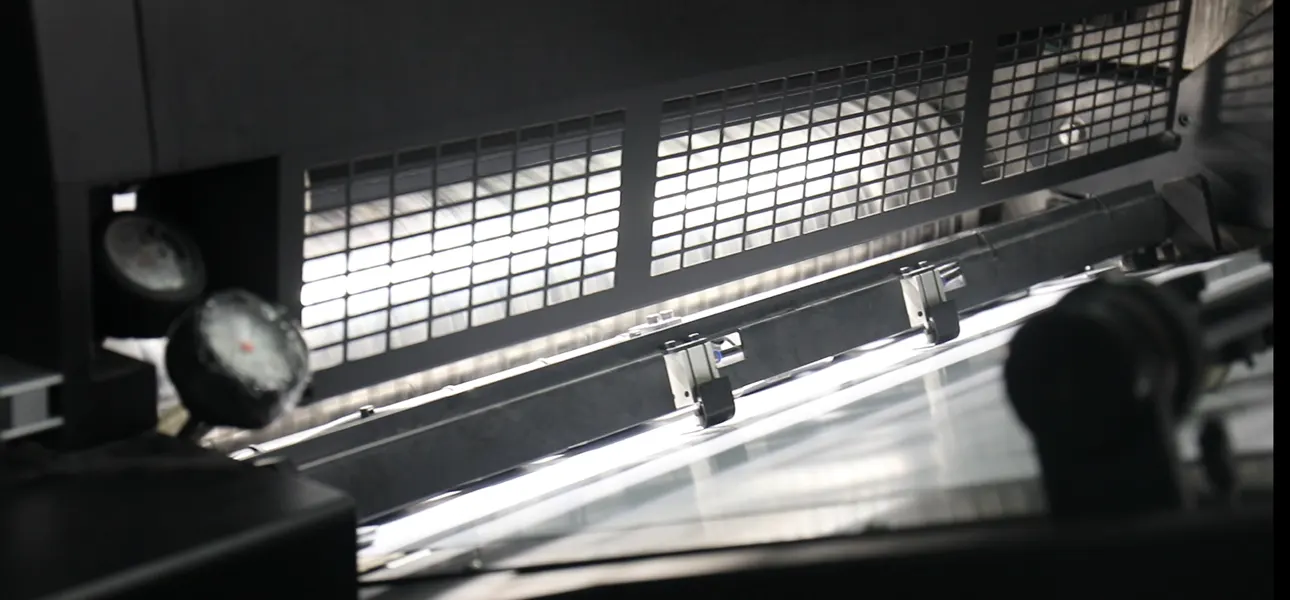
At the broadest level, offset lithography splits into two approaches based on how the non-image areas of the plate are kept ink-free.
Wet, or conventional, offset is the standard method. It uses a water-based dampening solution, also called fountain solution, that coats the non-image areas so they repel the oil-based ink. The balance of water and ink is what the press operator manages throughout the run. This is the process behind the vast majority of offset printing.
Waterless offset removes the water entirely. Instead of a dampening solution, the plate carries a silicone layer on its non-image areas that repels ink on its own. Developed in the 1960s and later commercialized by Toray, waterless offset can produce very sharp dots and strong color because it eliminates the water-ink balancing act, though it requires tighter temperature control on press. Most commercial offset, including ours, is wet offset; waterless is a specialized choice for particular high-fidelity work.
Variations of the Offset Process
As offset spread across different applications, presses were engineered in several configurations to suit specific needs. These are the main variants you will encounter.
Blanket-to-blanket. This configuration prints both sides of the sheet at once. It uses two blanket cylinders and two plate cylinders per color, with each blanket also acting as the impression surface for the other side. Because there is no separate impression cylinder, the sheet passes between two blankets and is printed front and back in a single pass. It is an efficient layout for high-volume two-sided work.
Blanket-to-steel. Here the impression cylinder is a hard steel cylinder rather than a second blanket, so the sheet is printed on one side at a time against that steel surface. The arrangement is precise, and on modern presses built with four, five, or eight units, it prints one color per unit, allowing full four-, five-, or eight-color work with tight registration.
Variable-size (sleeve) printing. Variable-size presses use removable cylinder sleeves that can be swapped to change the print repeat length quickly. Rather than being locked to one fixed sheet or cut-off size, the press can be reconfigured for different repeat lengths, which makes it a cost-effective option when a job calls for a non-standard size.
Keyless offset. Keyless inking supplies fresh ink on every revolution of the cylinder and removes any residual ink from the previous revolution, so ink never builds up unevenly across the run. The result is highly consistent ink density from start to finish. This approach is associated with high-speed work such as newspaper printing, where steady density across a long run matters.
Dry offset (letterset). Dry offset, sometimes called letterset, uses a metal-backed photopolymer relief plate similar to a letterpress plate, but the ink is still transferred to a rubber blanket before reaching the substrate rather than printing directly. Because it does not rely on the water-ink balance, it suits non-paper substrates and is commonly used to print on rigid plastic items such as tubs, cups, and containers.
Most everyday commercial printing, including books, card decks, and packaging, is produced on conventional wet sheet-fed presses in a blanket-to-steel style configuration with one unit per color. The other variants exist to serve specific volume, size, or material requirements.
Four, Five, and Eight-Color Presses
Beyond the process variant, an offset press is also defined by how many printing units it has. Each unit lays down one ink, so the number of units sets how many colors the press can print in a single pass.
| Press | What it prints in one pass |
|---|---|
| 4-color | Full-color CMYK: cyan, magenta, yellow, and black, the basis of most color printing |
| 5-color | CMYK plus one extra unit, typically for Pantone spot color, or for a varnish or special ink |
| 8-color | CMYK plus four extra units for multiple spot colors, metallics, white ink, or inline coating, or for printing both sides at once |
The extra units on five and eight-color presses are what allow exact brand-color matching with Pantone inks, special effects such as metallic or fluorescent inks, white ink underprinting on dark or specialty stocks, and inline varnishing. A longer press means more of the work happens in one pass, with better registration between colors and effects.
At QinPrinting we run Heidelberg and Komori sheet-fed presses in four-color, five-color, and eight-color configurations, with GMG Color Proof software keeping color consistent from proof to press.
Which of These Affects Your Project?
For most clients, the process variant is something we handle on the production side; you do not need to specify it. What matters to your project is usually the number of colors and effects, which determines whether the job runs on a four, five, or eight-color press. If you need exact Pantone matching, metallic or fluorescent inks, white ink on a dark stock, or an inline coating, that points to a five press. We select the right configuration for your specifications when we quote and produce the job.
Frequently Asked Questions
What is offset lithography?
Offset lithography is the full technical name for offset printing. It is a process in which an inked image is transferred from a flat plate to a rubber blanket and then onto the paper, working on the principle that oil and water do not mix. The word offset refers to that intermediate transfer through the blanket.
What is the difference between wet and waterless offset?
Wet, or conventional, offset uses a water-based dampening solution to keep the non-image areas of the plate ink-free. Waterless offset replaces the water with a silicone layer on the plate that repels ink on its own. Waterless can produce very sharp results but needs tighter temperature control; most commercial offset is wet offset.
What is blanket-to-blanket printing?
Blanket-to-blanket is an offset configuration that prints both sides of a sheet at the same time. It uses two blanket cylinders and two plate cylinders per color, with each blanket acting as the impression surface for the opposite side, so the sheet is printed front and back in a single pass.
What is dry offset printing used for?
Dry offset, also called letterset, uses a photopolymer relief plate but still transfers ink through a rubber blanket. Because it does not depend on a water-ink balance, it works well on non-paper substrates and is commonly used to print on rigid plastic items such as tubs, cups, and containers.
Do I need to choose the offset process variant for my job?
No. The process variant is a production decision we make for you. What affects your project is the number of colors and any special inks or coatings, which determines whether it runs on a four, five, or eight-color press. We select the right setup when we quote and print the job.