 Book Printing in China
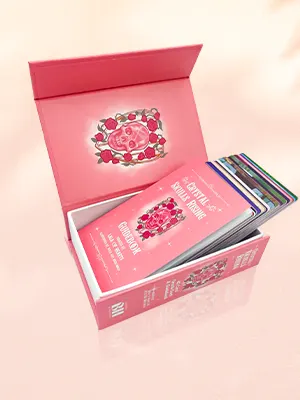 Custom Card Decks
 Custom Holographic Cards
 Free Wall Calendar Template
 Free Desk Calendar Template
 Folding Cartons
 Rigid Boxes
 Corrugated Boxes
 Custom Board Game
 Custom Card Game
 Kickstarter Print Solutions
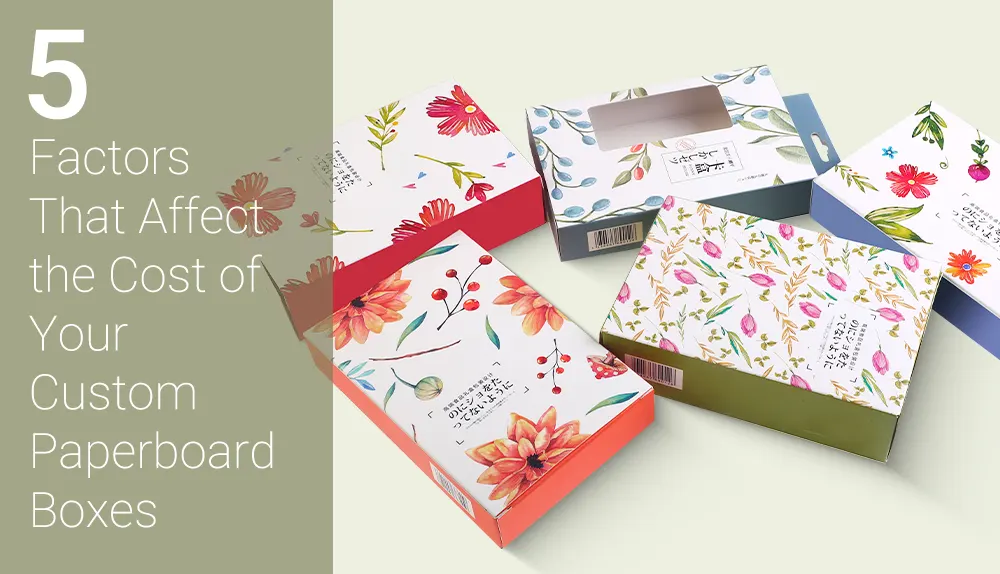
When planning a packaging project, understanding what drives the cost of custom paperboard boxes is essential for making smart budget decisions. Whether you’re launching a new product line or refreshing your brand’s packaging, knowing these five key pricing factors will help you balance quality, aesthetics, and cost-effectiveness.
Let’s break down each factor so you can make informed choices for your next packaging order.
1. Order Quantity: The Power of Scale
Order quantity is often the most significant factor affecting your per-unit cost. The relationship between quantity and price follows a simple principle: the more you order, the less you pay per box.
Why Quantity Matters So Much
Producing custom paperboard boxes involves several fixed costs that remain constant regardless of order size:
- Die-cutting tools — Custom dies are created specifically for your box dimensions and must be manufactured before production begins.
- Printing plate setup — Each color in your design requires CTP plate preparation and press calibration.
- Machine setup time — Production lines need configuration for each unique production process.
When you order 500 boxes, these setup costs are divided among 500 units. Order 5,000 boxes, and the same costs spread across ten times as many units, dramatically reducing your cost per piece.
Practical Quantity Considerations
For most businesses, there’s a “sweet spot” where additional volume yields diminishing returns on per-unit savings. Here’s how to think about it:
- Small runs (300–500 units) work best for market testing, limited editions, or premium products where packaging cost is a smaller percentage of overall product value.
- Medium runs (1,000–5,000 units) offer meaningful cost reductions and suit established products with predictable demand.
- Large runs (10,000+ units) maximize economies of scale but require storage space and confident demand forecasting.
Before committing to a large order, consider your storage capacity, product shelf life, and the risk of design changes that could make excess inventory obsolete.
2. Materials: Choosing the Right Paperboard
The paperboard you select directly impacts both the cost and perceived quality of your packaging. Different materials serve different purposes, and understanding your options helps you avoid overpaying for unnecessary specifications—or underinvesting in crucial structural integrity.


Common Paperboard Types and Their Applications
Coated One Side Cardboard (C1S) is a budget-friendly option that meets the needs of most standard paperboard boxes. Since many boxes are used only once, C1S paired with surface treatments like matte lamination, gloss lamination, or soft-touch lamination delivers solid results at an economical price point. This makes it ideal for everyday retail packaging where cost efficiency matters.
Solid Bleached Sulfate (SBS) features a bright white surface that’s ideal for high-end printing. It’s commonly used for cosmetics, pharmaceuticals, and premium food packaging where visual appeal matters most. SBS costs more but delivers superior print quality and a luxurious feel.
Brown or White Kraft Paper offers excellent strength with a natural, organic appearance. It’s popular for eco-conscious brands and food packaging where an artisanal, sustainable look meets functional durability. Kraft paper typically costs less than SBS while still accepting quality printing, and it resonates with environmentally aware consumers.
Premium Textured or Colored Cardstock provides a distinctive tactile experience and elevated visual appeal, making your packaging stand out immediately. These specialty materials are perfect for luxury products, gift boxes, or brands that want to make a strong first impression through touch. The premium feel comes at a higher price, but for the right products, the investment pays off in perceived value.
Thickness Considerations
Paperboard thickness, measured in points or GSM (grams per square meter), affects both protection and cost:
- Thinner stock (300–350 GSM) suits lightweight products and reduces material costs. Good for items that don’t need heavy protection.
- Medium weight (350–400 GSM) balances durability with economy for most applications. This range works well for the majority of retail products.
- Heavy stock (400+ GSM) provides premium rigidity for luxury goods or heavier contents. The substantial feel signals quality before the box is even opened.
Always request samples at different thicknesses to assess how each option feels in hand. The perceived quality difference between paperboard weights often exceeds their price difference—a small upgrade can significantly elevate your brand presentation.
3. Surface Finishes: Enhancing Visual Impact
Surface treatments transform basic printed boxes into eye-catching packaging that elevates your brand. However, each finishing technique adds processing steps—and costs—to your project.
Popular Finishing Options
Lamination applies a thin plastic film over printed surfaces. Matte lamination creates a sophisticated, understated feel, while gloss lamination delivers vibrant colors and high shine. Soft-touch lamination adds a velvety texture that customers love to hold. Beyond aesthetics, lamination protects against scuffing, moisture, and fingerprints.
Varnish coatings offer similar protection at a slightly lower cost than lamination, but only when ordering large quantities with offset printing varnish applied inline during the print run. For smaller orders, the cost advantage disappears. Spot UV varnish selectively highlights specific design elements—like logos or product names—with a glossy accent against matte backgrounds, creating eye-catching contrast.
Embossing and debossing create raised or recessed textures in the paperboard itself. These tactile elements add dimensionality that photography can’t fully capture, making them especially effective for luxury positioning and memorable unboxing experiences.
Foil stamping uses metallic or holographic foils to create brilliant, reflective accents. Gold, silver, rose gold, and custom multi-color foils catch light beautifully and instantly convey premium quality.
Balancing Finish Costs
Each additional finish increases your project cost, but strategic combinations can maximize impact without excessive spending:
A single well-placed foil accent often delivers more perceived value than multiple competing treatments.
Matte lamination with spot UV creates striking visual contrast cost-effectively.
Soft-touch lamination alone can transform an economical design into a premium-feeling package.
Consider which elements of your design deserve emphasis, and invest your finishing budget there rather than applying treatments uniformly across the entire surface.
4. Box Dimensions: Size and Complexity
Your box’s size directly influences material consumption, production efficiency, and shipping costs. Thoughtful dimension planning can yield significant savings without compromising packaging function.
How Size Affects Cost
Larger boxes require more paperboard, more ink, and more processing time. However, the relationship isn’t always proportional—a box twice as large doesn’t necessarily cost twice as much, because setup costs remain fixed.
More importantly, standard paperboard sheets come in specific sizes. Boxes designed to maximize material yield from these sheets cost less than dimensions that create excessive waste. Your packaging supplier can advise on efficient sizing, or you can use our online instant quote calculator to compare pricing across different dimensions and find the most economical size for your needs.
Dimension Optimization Strategies
Fit your product closely. Excess interior space means you’re paying for paperboard that serves no purpose. Custom-fitted inserts or form-fitting box designs protect products while minimizing material use.
Consider shipping implications. Dimensional weight pricing means oversized boxes cost more to ship, even when products are light. The packaging savings from efficient dimensions compound throughout your supply chain.
Account for retail display. If your boxes will sit on shelves, verify that dimensions work with standard retail fixtures. Non-standard sizes may require costly accommodation or limit your placement options.
5. Box Structure: Complexity and Construction
The structural design of your paperboard box—how it opens, closes, and assembles—significantly impacts production costs. Simpler structures cost less; complex designs offer functionality or visual distinctiveness at higher prices.
Common Box Styles and Their Cost Implications
Tuck-end boxes feature flaps that fold and tuck to close. They’re economical to produce and assemble, making them popular for retail products across many industries. The straightforward design keeps both manufacturing and fulfillment costs low.
One-piece tuck-top boxes ship flat and require manual assembly when packing products. This structure reduces production costs significantly since no gluing is needed at the factory. However, keep in mind that your fulfillment team will spend more time assembling each box, so factor in labor costs when comparing options. These work well for lower-volume operations or when you have efficient packing workflows.
Sleeve and tray combinations consist of separate sliding components. They create an unboxing experience that feels premium but requires more material and assembly steps. The “drawer” action adds a moment of anticipation that luxury brands often leverage.
Window boxes include die-cut openings, often with clear PET film, to showcase products inside. The additional die-cutting and film application increase costs but enable product visibility without opening—valuable for retail environments where customers want to see what they’re buying.
Structural Decisions That Affect Budget
Beyond the basic style, specific structural features carry cost implications:
Auto-bottom designs speed assembly dramatically but require more complex die-cutting. Worth it for high-volume fulfillment operations.
Multiple compartments add internal die-cuts and potentially separate inserts. Great for product sets or protecting multiple items.
Custom closures like ribbon pulls or magnetic snaps require additional materials and assembly steps.
Unusual shapes (hexagonal, triangular, asymmetric) need custom tooling and produce more waste from standard sheet sizes. They stand out on shelves but cost more to produce.
Match structural complexity to your product’s positioning. A premium fragrance justifies elaborate packaging that a commodity product cannot support economically.
Making Cost-Effective Decisions
Understanding these five factors—quantity, materials, finishes, dimensions, and structure—empowers you to make strategic trade-offs. You might choose a simpler box style to fund premium finishing, or specify lighter paperboard to afford larger quantities.
The most successful packaging projects align these choices with clear priorities: What must this packaging accomplish? Where will customers perceive value? Which elements differentiate your brand?
When you’re ready to explore options for your project, requesting samples at various specifications helps you see and feel how different choices affect the final product. Most importantly, communicate your budget constraints and priorities clearly—experienced packaging partners can suggest optimizations you might not have considered.
Looking to get started with custom paperboard packaging? Explore our custom paperboard boxes options and request a quote tailored to your specific requirements.