 Book Printing in China
 Custom Card Decks
 Custom Holographic Cards
 Free Wall Calendar Template
 Free Desk Calendar Template
 Folding Cartons
 Rigid Boxes
 Corrugated Boxes
 Custom Board Game
 Custom Card Game
 Kickstarter Print Solutions

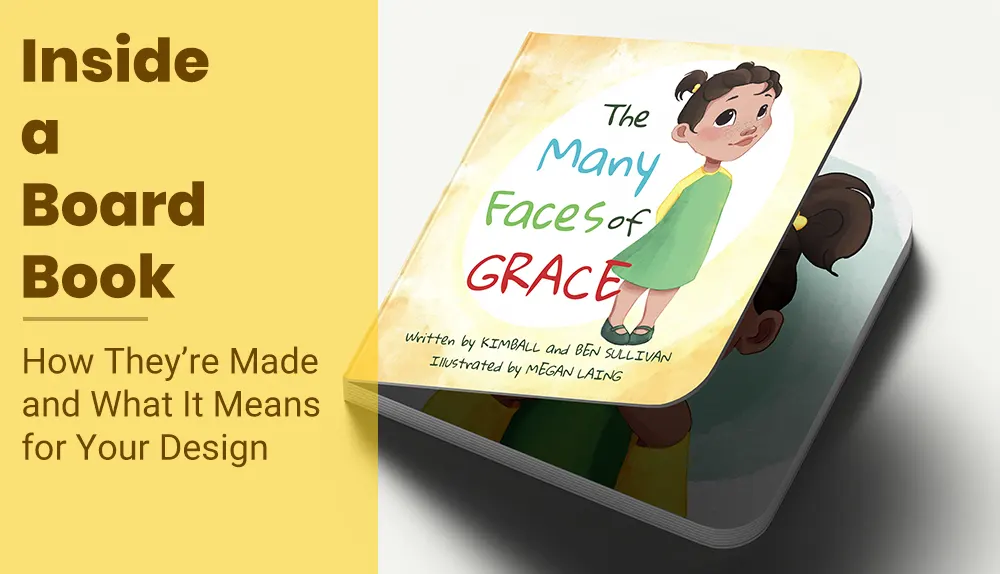
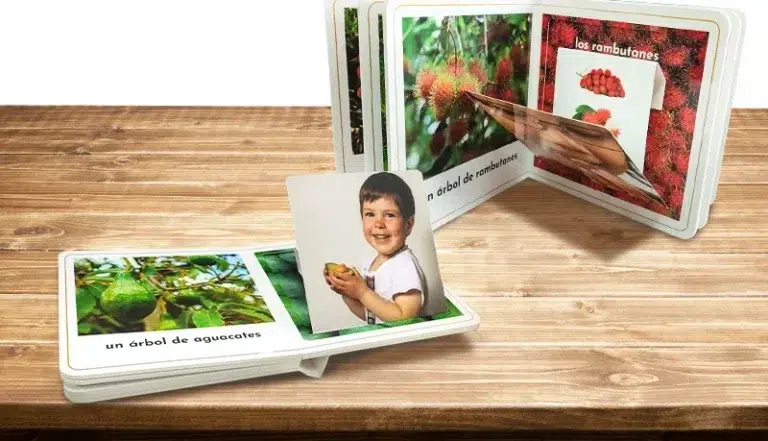
Pick up any board book and you’ll notice immediately that it feels different from every other book you’ve ever held. The pages are thick — almost like cardboard. They open completely flat without any resistance at the spine. The corners are rounded. The whole thing feels like it could survive being thrown across a room by a two-year-old, because it can.
What most authors and illustrators don’t realize — until they’re preparing files for their first board book print run — is that this distinctive feel is the direct result of a construction method that’s fundamentally different from any other binding. And that construction method has specific, practical implications for how you design the book.
This article explains how board books are manufactured, and what each step of that process means for your design decisions and page count — before you go to print.
The Basic Construction: Why Board Book Pages Are Different
A board book page is not a single sheet of paper. It is two sheets fused together.
Here is what happens in production: we print your artwork on heavy paperboard — typically 350 gsm C1S stock, which is coated on one side for sharp ink reproduction and uncoated on the other side to take adhesive. Each sheet is printed as a two-page spread: the left and right pages that you see simultaneously when the book is open. That spread is then scored down the center, folded, and coated with adhesive on its open edges.
Repeat this for every spread in your book, stack them in order, press them together, and you have a board book page block. The front and back covers are simply the outermost faces of the first and last spread. The spine is the glued edge of the stacked block.
The result is a structure with no sewing, no wire, and no spine glue of the kind used in paperbacks or hardcovers. The pages are held entirely by the adhesive between the doubled sheets — which is why the paper weight matters so much. Lighter stock would not hold enough adhesive to survive the kind of handling a board book gets.
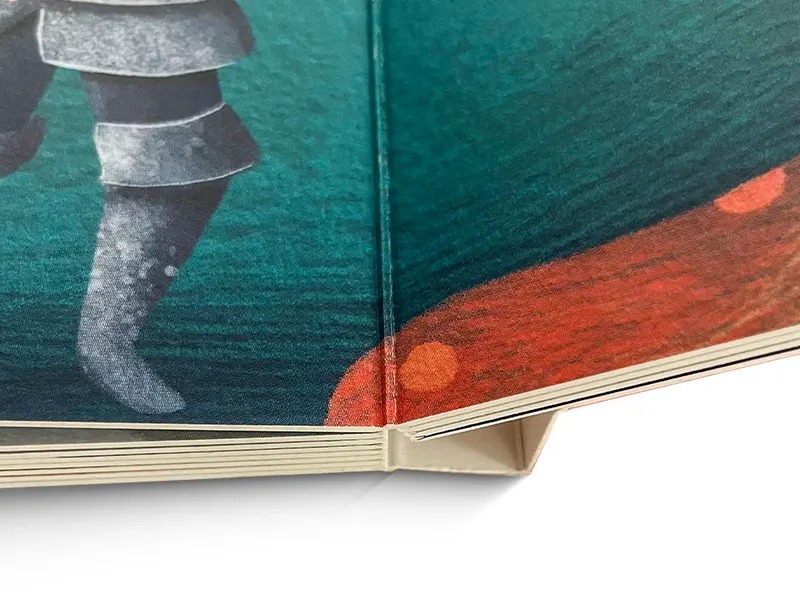
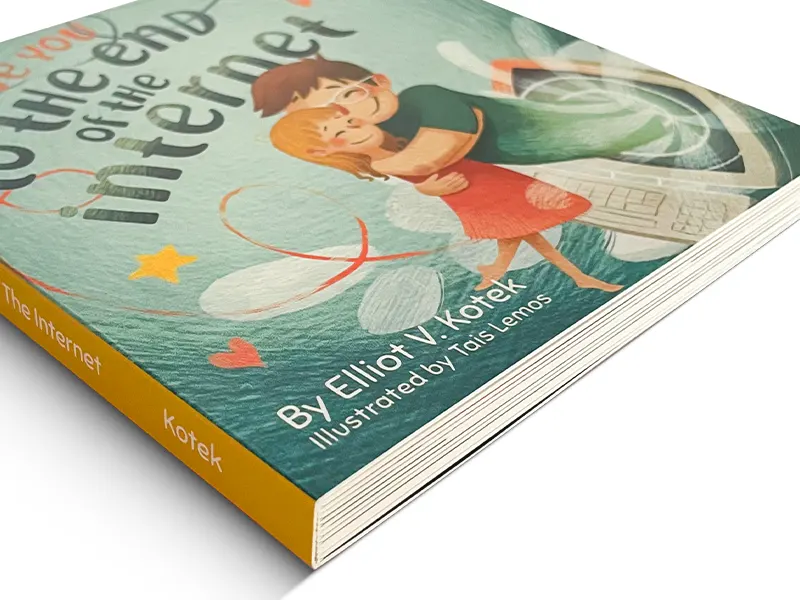
- What this means for you: If you look at the edge of any board book page, you will see a thin seam running down the center — that is the fold line where the two layers meet. This is normal and expected. It is not a defect. You cannot design around it or eliminate it; it is an inherent feature of the construction.
Why Board Books Open Completely Flat — and How to Use It
The most distinctive property of a board book is that it opens to 180 degrees and stays there. There is no tension at the spine pulling the pages back toward closed. Lay it on a table and it stays open. Hand it to a toddler and the pages stay visible without anyone holding the book open.
This happens because of how the book is constructed. Each page spread is glued edge-to-edge to build up the page block — but two areas are deliberately left unglued: the section between the spine and the fold line on the back cover, and the spine area of the cover itself, which is not adhered to the interior block. These unglued zones act as hinges, giving the cover freedom to open fully without pulling the pages back toward closed. Unlike a perfect-bound paperback (where the pages are locked into a spine that resists opening) or a sewn hardcover (where the signatures curve toward the spine), a board book has nothing fighting the flat position.
For you as a designer, this is not just a functional feature — it is a design opportunity that most board book creators underuse.
Design in spreads, not pages
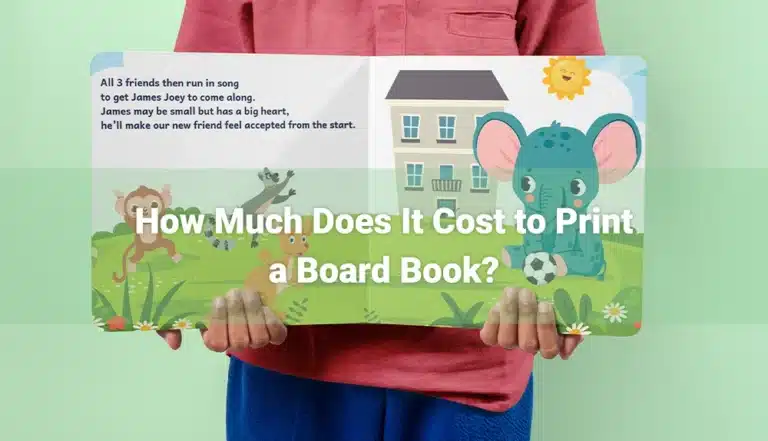
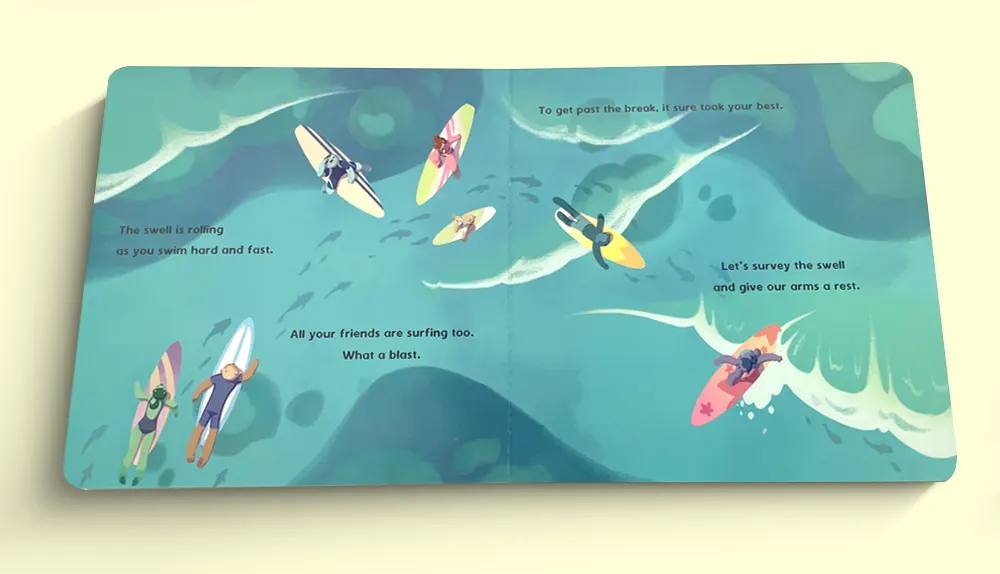
Because a board book always shows two pages simultaneously, and because there is no gutter shadow or page curve at the center, the full width of the spread is usable illustration space. An image that starts on the left page and continues across to the right page will appear seamless — no dark gap in the middle, no distortion at the fold.
This is fundamentally different from a hardcover or paperback, where a gutter-crossing illustration loses part of itself into the spine. In a board book, the gutter crossing is your friend.
The practical implication: design your most important artwork as full spreads. Set up your files as facing pages in your design software, and export them as spread PDFs. If you set up your files page-by-page and treat the center of each spread as a boundary to avoid, you are designing against the format rather than with it.
Why the Page Count Has a Hard Upper Limit
Every board book page is double the thickness of a standard book page — because every page is made from two sheets fused together. Stack 32 of those pages and you have a noticeably chunky book. Stack 64 and you have a book that is physically difficult to open and hold flat. Go further still, and the lay-flat property starts to break down under the accumulated tension of all that paper.
The upper limit is not a fixed number — it depends on the book’s size and paper weight. For standard 8″×8″ or smaller formats printed on 350 gsm C1S paper, we recommend a maximum of 64 pages. For larger formats using lighter 210 gsm C1S paper, the construction can support up to 80 pages while still opening flat. Beyond those thresholds, the book stops behaving like a board book and starts behaving like a brick.
This is why board books have a practical page count ceiling of 64–80 pages depending on spec. It is not an arbitrary rule — it is a physical constraint of the construction.
| Page count | What to expect | Best for |
|---|---|---|
| 8 pages | Minimum. Very thin — the book has just 4 visible spreads. Will feel slight. | Extremely simple concept books: single word per spread, one object per page. |
| 12–16 pages | The sweet spot for baby books. Enough content for a complete concept, easy to handle. | Number books, color books, animal books for 0–2 year olds. |
| 24–32 pages | The most common range. Enough space for a complete narrative arc. | Picture books with a story, character-driven titles, books for 2–4 year olds. |
| 48–80 pages | Noticeably thick. Still printable, but the book is chunky. | Alphabet books, activity concepts that need more spreads. Not recommended for very young readers. |
| Over 80 pages | Not recommended. Lay-flat property degrades. Production difficulty increases. | Consider a different format — hardcover or paperback — if you need this many pages. |
- Design implication:If your manuscript or concept is running over 32 pages in the layout stage, board book format may not be the right choice — or the content may need editing. This is worth knowing before the illustration work begins, not after. If you have a firm concept that genuinely needs more space, a hardcover picture book with standard paper pages is a better fit than a very thick board book.
Standard Board Book vs Hardcover Board Book: Which Construction Is Right for Your Project?
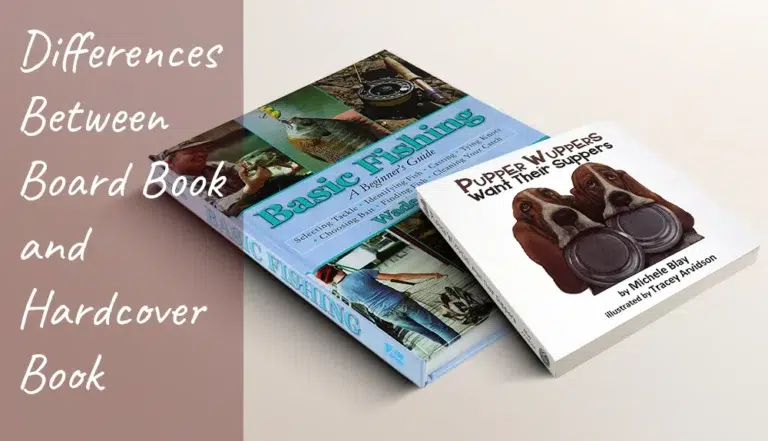
One thing that confuses many first-time board book publishers: there are actually two types of board book, and the construction difference between them matters for your project budget and positioning.
Both types use exactly the same interior page construction — the same 350 gsm C1S paper, the same fold-and-glue method, the same lay-flat result. The difference is entirely in the outer cover.
| Standard Board Book | Hardcover Board Book | |
|---|---|---|
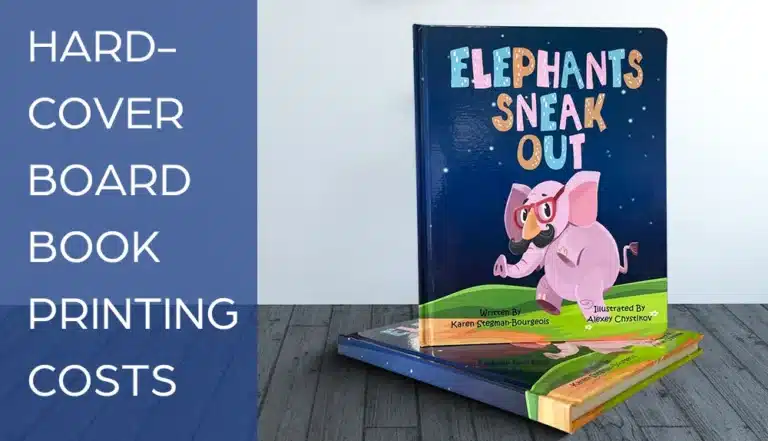
| Cover construction | The cover is the outermost face of the page block — same material as the pages, no separate case. | A separate gray-board case (3 mm thick) wrapped in printed paper, cloth, or leather. Attached to the page block via the outermost spread. |
| Cover feel | Firm, slightly flexible — the same stiffness as the page block. | Rigid, noticeably harder — clearly a separate hard case. |
| Lay-flat opening | 180 degrees | 180 degrees. The hard case does not affect the opening angle. |
| Cover finish options | Matte/gloss/soft-touch lamination, spot UV, foil, rounded corners. | All of the above, plus: cloth or leather wrap, foil on spine, dust jacket. |
| Per-copy cost | Lower — most economical board book option. | Approximately 25–35% more at the same size and page count. |
| Best for | Most children's picture books, baby books, mass-market titles. | Keepsake editions, gift books, premium children's titles, collector's runs. |
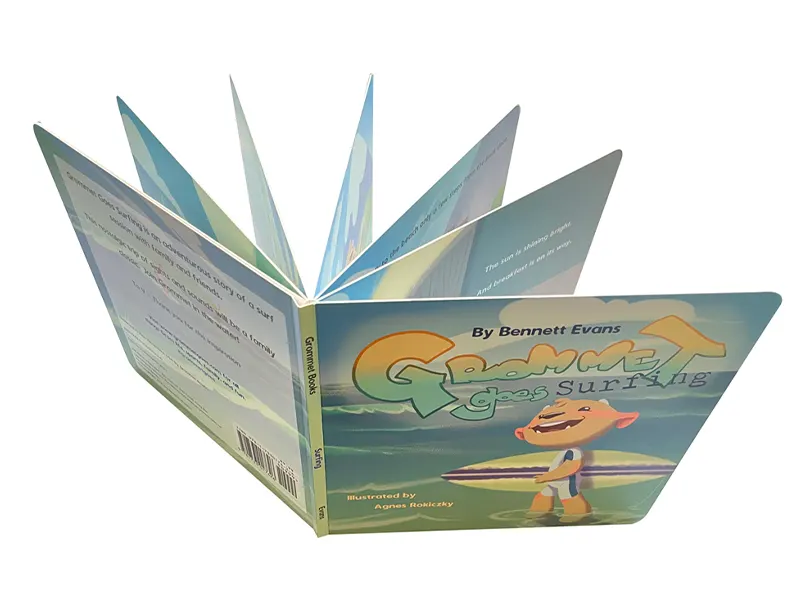
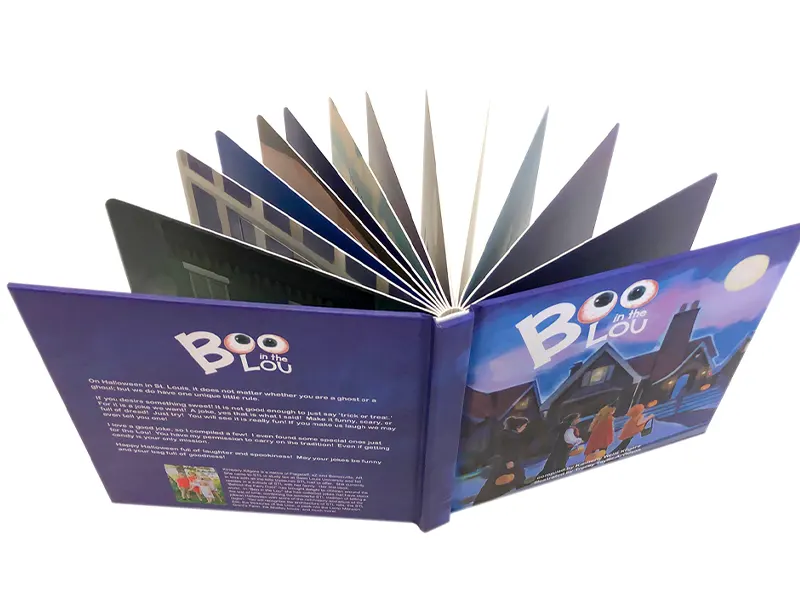
For most self-publishing projects, the standard board book is the right choice — it is the format that parents, teachers, and retailers expect, and it is more economical per copy. The hardcover board book makes sense when the physical feel of the cover is a meaningful part of what you are selling: a gift book, a keepsake, a limited edition.
- Design implication:If your manuscript or concept is running over 32 pages in the layout stage, board book format may not be the right choice — or the content may need editing. This is worth knowing before the illustration work begins, not after. If you have a firm concept that genuinely needs more space, a hardcover picture book with standard paper pages is a better fit than a very thick board book.
For a full three-format comparison (standard board book, hardcover board book, and hardcover book),
see: Board Book vs. Hardcover Book: All Three Formats Explained
Five Things That Surprise First-Time Board Book Publishers
After printing board books for publishers and independent authors for over 35 years, these are the five things that most consistently catch first-time clients off guard.
1. The page count is lower than you think
Most authors come to us with a manuscript that has been laid out as a 40- or 48-page book, because that’s what they’re used to from picture books. In board book format, 40 pages is already on the chunky side. If your story can be told in 24 or 32 pages, it will be a better board book — easier to handle, less expensive to produce, and more appropriate for the age group.
2. Board books cost more per copy than hardcovers — not less
This surprises almost everyone. The intuition is that a smaller, simpler book should cost less than a large, complex hardcover. In reality, board books cost 20–45% more per copy than a hardcover of the same size and page count, because every page uses double the paper stock and requires significantly more adhesive. Knowing this upfront helps you set a realistic budget.

3. Production takes longer than a standard book
A board book takes 15–18 business days to produce after proof approval — roughly 5–8 days longer than a comparable hardcover or paperback. The fold-and-glue construction involves more manual handling steps than standard binding, and the adhesive cure time between stages adds to the schedule. Add sea freight shipping (5–6 weeks to the US) on top, and the total timeline from file submission to delivery is typically 8–10 weeks. Plan around this, especially if you have a launch date or a seasonal window in mind.
4. You need to design the spine
Authors who have previously published digital-first or print-on-demand books are often not in the habit of designing spines, because POD spines are too narrow to be useful. A 24-page or 32-page board book has a spine wide enough for a title and author name in a legible size. Include it in your cover brief — it matters for shelf presence.
5. Gutter-crossing artwork is an advantage, not a risk
On a standard paperback or hardcover, artists are often cautious about running artwork across the center fold because the gutter can obscure part of the image. On a board book, the lay-flat construction eliminates this problem entirely. You can run a single continuous image across the full width of any spread and it will appear perfectly flat and uninterrupted. This is one of the format’s most underused strengths.
Frequently Asked Questions
Q: How are board books different from regular children's picture books?
The main difference is the page construction. A board book page is two sheets of heavy paperboard (350 gsm) fused together, making it thick, stiff, and resistant to tearing. A picture book page is a single sheet of standard paper (100–157 gsm), much thinner and easier to tear. Board books are designed specifically for children aged 0–4 who handle books roughly. Picture books with standard paper pages are typically aimed at children aged 3 and up who have developed enough fine motor control to turn pages carefully.
Q: Why do board books open flat when other books don't?
Because of how the pages are bound. In a standard paperback or hardcover, the pages are glued or sewn into a spine structure that creates tension pulling the pages back toward closed. In a board book, the pages are stacked and glued edge-to-edge with no spine structure to create that tension. The book naturally rests flat at 180 degrees.
Q: Can I design full-spread illustrations that cross the center of the book?
Yes — and board books are the ideal format for this. Because the book opens completely flat with no gutter shadow or page curve, an illustration that crosses from the left page to the right page appears as a single, uninterrupted image. This is one of the key design advantages of the format. Set up your files as facing pages (spread layout) and design your most important illustrations as full spreads.
Q: What is the maximum page count for a board book?
We recommend a maximum of 64-80 pages. Beyond this, the accumulated thickness of the double-layered pages makes the book difficult to open and hold flat, and the lay-flat property starts to degrade. Most children’s board books are 12–32 pages. If your concept requires more than 64 – 80 pages, a hardcover or paperback picture book is a better format choice.
Q: What is the difference between a standard board book and a hardcover board book?
Both use exactly the same interior page construction — 350 gsm paperboard, double-layered, lay-flat at 180 degrees. The difference is the cover. A standard board book’s cover is the outermost face of the page block — the same material as the pages. A hardcover board book has a separate gray-board case (like a traditional hardcover) wrapped in printed paper, cloth, or leather. Both open flat. The hardcover version costs roughly 25–35% more per copy and is suited to premium or gift editions.
Q: Do I need rounded corners on my board book?
Rounded corners are standard practice for children’s board books and we recommend them for any title aimed at children under 4. They eliminate sharp 90-degree corners that could scratch a young child’s face, and they give the finished book a cleaner, more polished appearance.
Q: How do I prepare my files for board book printing?
Key requirements: press-ready PDF, CMYK color mode, 300 dpi minimum resolution, 3 mm bleed on all sides, 5 mm safe zone from the trim edge (slightly larger than standard), files set up as spreads (not single pages). Download our free board book templates at qinprinting.com/templates/ for the correct file setup for your size and format. Our pre-press team checks every file manually and for free before production begins.
Ready to Print Your Board Book?
If this article has helped clarify the format decisions for your project, the next step is getting your spec quoted. Our instant online quote tool gives you a per-copy price in under 60 seconds — no email required.