 Book Printing in China
 Custom Card Decks
 Custom Holographic Cards
 Free Wall Calendar Template
 Free Desk Calendar Template
 Folding Cartons
 Rigid Boxes
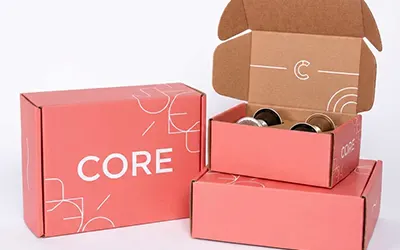 Corrugated Boxes
 Custom Board Game
 Custom Card Game
 Kickstarter Print Solutions
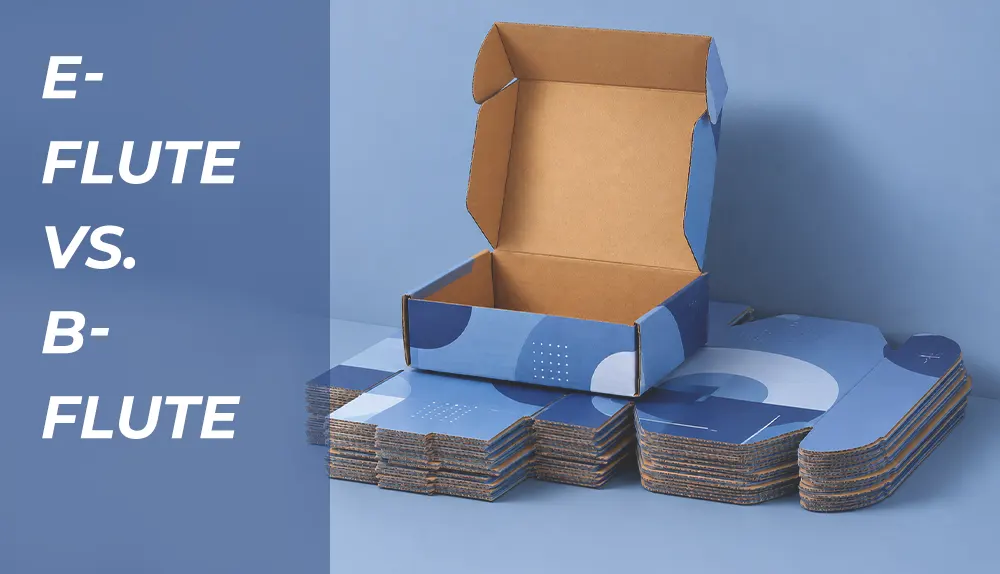
When you order custom mailer boxes, one of the first technical choices you’ll make is the corrugated flute — and for mailer boxes, the decision almost always comes down to E-flute vs. B-flute. Both are popular, both ship products safely, and (because of how we print and laminate them) both carry the same crisp, full-color finish — but they behave differently when it comes to thickness, strength, cushioning, and how sharp the folded box looks. Choosing the right one keeps your product protected and your box looking sharp, without paying for more material than you need.
This guide explains what corrugated flutes actually are, how E-flute and B-flute compare, and how to pick the right one for your product.
What Is a Corrugated Flute?
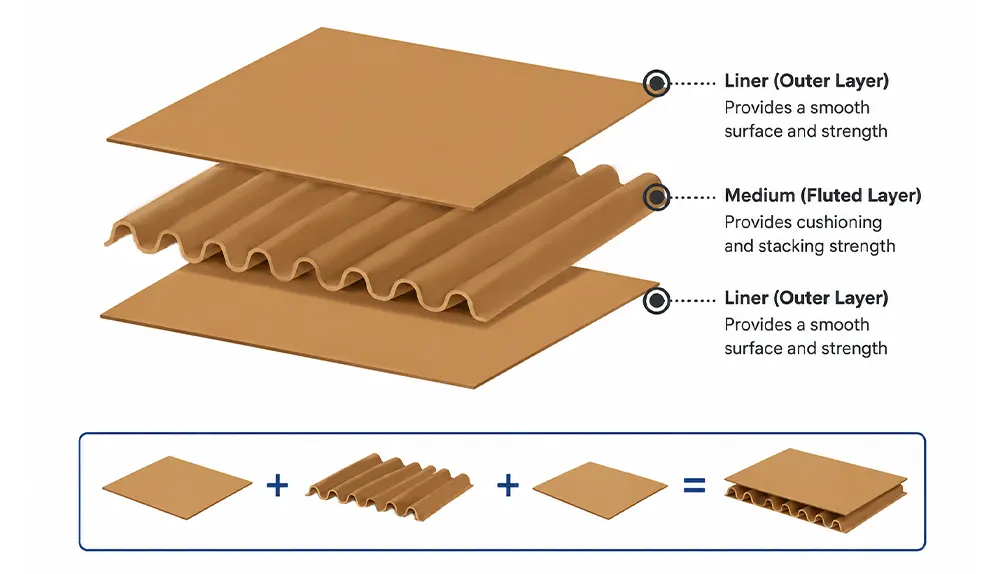
Corrugated board is made of three layers: a wavy, fluted middle layer (the medium) glued between two flat outer layers (the liners). Those S-shaped waves are the “flutes,” and they’re what give corrugated its strength and cushioning — like tiny arches that resist crushing and absorb impact.
Flutes come in standardized profiles, named by letter, that differ mainly in how tall the waves are and how many fit per foot. The taller the flute, the thicker the board and the more cushioning it provides; the shorter and finer the flute, the smoother and more print-friendly the surface. For mailer boxes, the two most common profiles are E-flute and B-flute.
E-Flute: Thin, Slim, and Sharp-Edged
E-flute is a fine, low-profile flute roughly 1.5 mm thick. Its closely spaced waves create a thin, firm board that folds into a slim, refined box with crisp corners — which is why it’s the go-to for branded retail and e-commerce mailer boxes where a precise, premium look matters.
E-flute is best when:
- Your product is light to medium weight
- Print quality and a premium unboxing look matter most
- You want a slim, refined box that isn’t bulky
- You’re shipping cosmetics, apparel, accessories, electronics, or subscription items
E-flute has one more advantage that’s easy to overlook: once the box is folded and assembled, its edges and corners come out crisper and sharper. Because the flute is finer, the fold lines are cleaner — so an E-flute box looks more precise and refined on the shelf or at the doorstep.
B-Flute: Stronger and More Protective
B-flute is a taller profile, roughly 3 mm thick, with bigger waves that deliver more cushioning and better crush resistance than E-flute. Because we laminate a printed 250gsm sheet onto the surface (more on that below), B-flute prints just as cleanly as E-flute — the print quality is essentially the same; the main differences are thickness, cushioning, and folded-edge sharpness.
B-flute is best when:
- Your product is heavier or needs more impact protection
- The box is on the larger side
- You want extra cushioning for fragile or premium items
- You’re balancing solid strength with still-good print quality
One trade-off to note: because B-flute uses a taller, larger wave, the corners of a folded B-flute box look slightly softer than E-flute’s — not as sharply defined at the edges. There’s also a subtle surface effect: even though both E-flute and B-flute boxes are built the same four-layer way, B-flute’s larger corrugation telegraphs through to the surface more noticeably, so the face of a B-flute box isn’t quite as flat and smooth as an E-flute box. For most products neither is a problem, but if razor-crisp corners and a perfectly flat surface are central to your look, it’s worth weighing.
E-Flute vs. B-Flute at a Glance
| E-Flute | B-Flute | |
|---|---|---|
| Approx. thickness | ~1.5 mm | ~3 mm |
| Cushioning | Light | Moderate |
| Crush resistance | Good | Stronger |
| Folded edge sharpness | Crisper, sharper corners | Slightly softer corners |
| Surface flatness | Flatter, smoother face | Corrugation shows through more |
| Print quality | Excellent (laminated sheet) | Excellent (laminated sheet) |
| Box bulk | Slim, refined | Slightly bulkier |
| Best products | Light–medium, branding-led | Heavier, protection-led |
| Typical use | Cosmetics, apparel, subscriptions | Fragile, larger, or premium goods |
How to Choose Between E-Flute and B-Flute
The decision usually comes down to a simple trade-off: print finesse and slimness (E-flute) versus extra protection and cushioning (B-flute). A few questions make it easy:
- How heavy and fragile is your product? Lighter and more durable leans E-flute; heavier or more delicate leans B-flute.
- How important are crisp corners? Because we laminate a printed sheet onto both flutes, print quality is essentially the same — but E-flute folds into sharper, more defined corners, so it has the edge when a precise look matters.
- How big is the box? Larger boxes benefit from B-flute’s added rigidity.
- Will it ship on its own or inside a master carton? A mailer that ships solo may want B-flute; one protected inside an outer shipping box can often use E-flute.
If you’re still unsure, send us your product details and we’ll recommend the flute that balances protection, print quality, and cost for your specific case. Explore materials and structures on our custom mailer boxes page.
What About Other Flutes?
E and B aren’t the only profiles. For very large or heavy boxes, C-flute and double-wall constructions (such as BC-flute) add significant stacking strength — these are more common on shipping cartons than on branded mailers. For mailer boxes specifically, E-flute and B-flute cover the vast majority of needs. If your project calls for heavier-duty corrugated, see the full range on our custom corrugated boxes page.
How We Print Our Mailer Boxes: Laminated, Book-Quality Color
Here’s something that sets our mailer boxes apart from a standard corrugated box, and it applies to both E-flute and B-flute. Rather than printing directly onto the corrugated board, we print onto a separate sheet of 250gsm cardboard first, then mount (laminate) that printed sheet onto the corrugated base.
In practice, the process works like this:
- We print your design — full-color CMYK or Pantone (PMS) spot colors — onto a 250gsm cardboard sheet.
- That sheet gets a gloss or matte lamination, which seals and protects the printed surface.
- The finished printed-and-laminated sheet is then mounted onto the 3-layer E-flute or B-flute corrugated board.
So the final box is effectively four layers: the standard three-layer corrugated structure, plus the printed 250gsm sheet laminated on top.
Why we print this way
Printing onto a smooth 250gsm sheet and then laminating it gives a noticeably better result than printing directly onto corrugated board. Images come out sharper, colors are more accurate and truer to your file, and fine detail holds up far better. When your print-ready artwork is high quality, the result can reach book-printing quality — the kind of crisp, faithful color reproduction you’d expect from a printed book cover.
Why every box gets lamination
Because we typically print in full color or Pantone, every E-flute and B-flute box we make receives a gloss or matte lamination on the surface. Beyond the premium look, lamination protects the printed artwork — the laminated surface resists scuffing and scratching during shipping and handling, so your box still looks sharp by the time it reaches your customer. Choose gloss for vivid, high-shine color, or matte for a soft, understated, premium feel.
Ordering Custom Mailer Boxes in E-Flute or B-Flute
At QinPrinting, custom mailer boxes are produced in your choice of flute, size, print, and finish, with a minimum order of 300 units and a 10–20 day production turnaround for corrugated boxes. You can get an instant online quote showing your EXW Shanghai price on the product page; for shipping costs to your destination, submit the quote form and we’ll reply within 24 hours. We also provide free artwork checks before production so your files are print-ready. Not sure which structure suits your product? Download a free dieline to plan your box.
FAQs
Which is better for mailer boxes, E-flute or B-flute?
Neither is universally “better.” E-flute is thinner with a smoother print surface, ideal for light-to-medium products and premium branding. B-flute is thicker with more cushioning, better for heavier or more fragile items. Match the flute to your product’s weight, fragility, and box size.
How thick is E-flute compared to B-flute?
E-flute is about 1.5 mm thick; B-flute is roughly 3 mm. B-flute’s taller waves provide more cushioning and crush resistance, while E-flute’s finer profile gives a smoother surface for detailed printing.
Can E-flute and B-flute be printed in full color?
Yes — both can. We print your design (full-color CMYK or Pantone) onto a 250gsm sheet, laminate it with gloss or matte, then mount it onto the corrugated board. Both flutes take this laminated sheet equally well, so you get the same crisp, book-quality color on either one.
What’s the minimum order for custom mailer boxes?
Our MOQ is 300 units, available in E-flute, B-flute, or other materials, with custom sizes and finishes.