 Book Printing in China
 Custom Card Decks
 Custom Holographic Cards
 Free Wall Calendar Template
 Free Desk Calendar Template
 Folding Cartons
 Rigid Boxes
 Corrugated Boxes
 Custom Board Game
 Custom Card Game
 Kickstarter Print Solutions
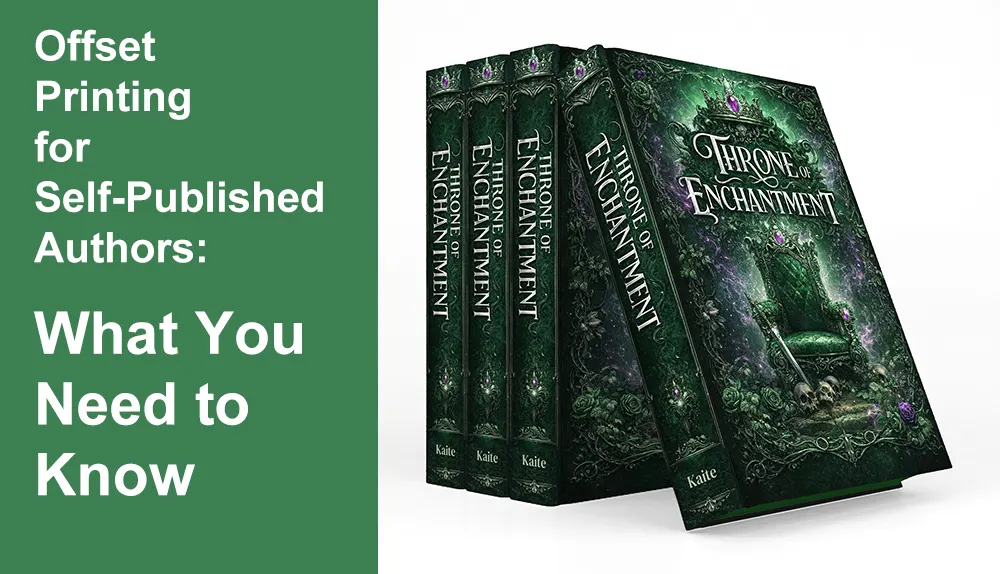
Self-published authors are some of my favorite clients. You pour your heart into your manuscript, often balancing a full-time job, family, and late-night writing sessions. When the book is finally ready to print, it can feel like stepping into a completely different world—full of terms like “offset”, “CMYK”, “bleeds”, and “lamination”.
After working with self-published authors for many years as an offset printer, I’ve noticed the same questions and misunderstandings appear again and again. In this article, I’d like to share what most self-published authors don’t know—but really should—about offset printing.
1. Offset vs digital: it’s not only about quality, but also about quantity
Many authors have heard that offset printing gives better quality than digital printing. That can be true for certain projects, but the real difference is often about quantity and unit cost.
- Digital printing is usually better for very small runs (for example, 20–100 copies), especially when you need them quickly.
- Offset printing shines when you move into higher quantities—often starting around 300–500 copies and above, depending on the book.
With offset, there are setup costs (plates, make-ready, etc.), but once the press is running, the cost per copy drops significantly as the quantity increases. This is why you might see something like:
- 100 copies: very high unit cost
- 500 copies: much lower unit cost
- 1,000 or 2,000 copies: even more attractive per-unit price
For many self-published authors, the surprise is:
“If I can sell or distribute these books over time, printing more copies at once can actually save me money.”

2. “Use your MOQ” doesn’t always mean what you think
A common question I receive is: “What is your MOQ?” or sometimes, authors simply say: “Use your MOQ.”
But MOQ (minimum order quantity) is not magic. A printer can technically produce even 100 copies on offset, but the unit cost may be too high to make sense for you. So there are really two “minimums”:
- The technical minimum we can produce
- The economic minimum that makes sense for your budget
When authors say “use your MOQ”, what they usually mean is:
“Give me a quantity that makes sense economically, not just technically.”
This is why it helps if you also share:
- Your target retail price
- Your approximate sales expectation (for example, a few hundred vs a few thousand)
- Whether you can store extra stock or not
With this information, we can suggest quantities that make economic sense, not just technically possible numbers.
3. File preparation matters more than you think
Many self-published authors come to us with fully designed files, but some essential prepress details are often missed. Here are a few key points:
- Bleeds: If your images or background colors go to the edge of the page, you need at least 3 mm (or 1/8″) bleed on all sides.
- Safe margins: Keep text and important elements at least 3–5 mm inside the trim line. This helps avoid cutting off text.
- Resolution: Images should be 300 dpi at final print size. Web images (72 dpi) usually print poorly.
- Color mode: Files should be provided in CMYK, not RGB. Otherwise, colors may shift unexpectedly.
- Black text: For small body text, use K100 (pure black), not rich black. This keeps text sharp.
- Spine width: For perfect-bound and hardcover books, the spine must match the paper thickness and page count. Your printer can calculate the spine width for you. You can download our book cover templates, which include calculated spine widths, here.
You don’t need to become a prepress expert, but understanding a few basics can save you time, money, and frustration. Understanding this difference early helps avoid disappointment and leads to much smoother approvals.
4. Color is not as “absolute” as your screen
Another surprise for many authors is how color works in print.
- Screens use RGB light, with brightness and contrast adjusted to your personal taste.
- Offset printing uses CMYK inks on paper, which absorbs some of the light.
As a result, printed colors can look:
- Slightly darker or less saturated than on screen
- Different on coated vs uncoated paper
- Slightly different between runs, depending on ink batches, paper, and environmental conditions
To manage this, professional printers often suggest:
- Hard proofs (such as GMG color proofs or press proofs) for color-critical projects
- Choosing paper and finishes that suit your artwork (for example, photos often look better on coated paper)
If consistent, accurate color is very important to you, tell your printer early. We can then suggest a proofing method and paper choice that match your expectations.
5. Production and shipping take longer than you think
Many self-published authors underestimate the timeline required for offset printing plus international shipping.
Typical stages include:
- File checking and prepress
- Proofing (digital or printed) and your approval
- Mass production (printing, binding, finishing, QC)
- Packaging and shipping (by air or sea)
Depending on your specifications, quantity, and shipping method, the whole process can take:
- Around 2–4 weeks for production once files and proofs are approved
- Plus shipping time (for example, several days by air, or 4–6 weeks by sea to some destinations)
If you have a book launch, signing event, or Kickstarter fulfillment deadline, it is much safer to work backwards from the date and add enough buffer time. In practice, starting early with printing for a Kickstarter project gives you far more room to adjust specifications and avoid last-minute issues.
6. Your printer is a partner, not just a vendor
Over the years, I’ve learned that the smoothest projects always start with early conversations. A good printer is not just someone who “pushes the print button”.
A good printer is a partner who can help you avoid problems and get the best result for your budget.
We can help you:
- Choose between paper options that affect weight, shipping cost, and feel
- Decide whether to add special finishes like foil stamping or soft-touch lamination
- Plan realistic quantities and timelines
- Optimize your files before they go to press
The earlier you involve us in your planning, the more value we can add.
If you’re a self-published author stepping into the world of offset printing, don’t be afraid to ask questions. We’d rather answer them at the beginning than solve problems at the end. Over the years, I’ve learned that the best printing results come from collaboration, not last-minute decisions. Your story deserves a book that does it justice.