 Book Printing in China
 Custom Card Decks
 Custom Holographic Cards
 Free Wall Calendar Template
 Free Desk Calendar Template
 Folding Cartons
 Rigid Boxes
 Corrugated Boxes
 Custom Board Game
 Custom Card Game
 Kickstarter Print Solutions
When it comes to self-publishing a book, selecting the perfect size is a crucial decision that significantly affects its aesthetics, readability, and marketability. At QinPrinting, a leading Chinese offset printing company, we understand the importance of choosing the right size for your self-published book. In this blog, we will explore the various factors to consider when determining the ideal size, empowering you to make an informed decision that aligns with your vision and target audience.
Common Book Sizes at a Glance
Before we look at each book type in more detail, here’s a quick reference table covering the most commonly used sizes across different genres. If you’re short on time, this is the fastest way to find a starting point for your project.
| Book Type | Recommended Size(s) | Format | Notes |
|---|---|---|---|
| Fiction (novel, romance, mystery, sci-fi) | 5.5" × 8.5", 6" × 9" | Paperback or hardcover | Industry standard. 5.5"×8.5" is slightly more compact; 6"×9" gives more white space. |
| Non-fiction, self-help, business | 6" × 9" | Paperback or hardcover | The most widely used size for trade non-fiction. Professional and bookshelf-friendly. |
| Textbooks and educational books | 7" × 10", 8.5" × 11" | Paperback or hardcover | Larger format accommodates diagrams, charts, and annotation space. |
| Coffee table books and art books | 8.5" × 11", 10" × 10", 11" × 11" | Hardcover | Larger formats showcase images more effectively. Square formats work well for photography. |
| Children's picture books | 8" × 8", 8.5" × 11", 8.5" × 8.5" (square) | Hardcover or paperback | Square and landscape formats are popular for full-spread illustrations. |
| Board books | 6" × 6", 7" × 7", 8" × 8" | Board book (standard or hardcover) | Smaller sizes suit very young readers; 8"×8" allows more illustration detail. |
| Comic books and manga | 6.625" × 10.25" (comic), 5" × 7.5" (manga) | Saddle stitch or perfect binding | These are established industry standards — sticking to them makes distribution easier. |
| Graphic novels | 6" × 9", 6.625" × 10.25" | Perfect binding or hardcover | Trade paperback (6"×9") fits standard bookshelf slots; larger formats suit detailed artwork. |
| Cookbooks | 7" × 10", 8.5" × 11" | Hardcover or lay-flat binding | Larger formats give more room for recipe layout and food photography. |
| Poetry and short essay collections | 5" × 8", 5.5" × 8.5" | Paperback | Smaller formats feel appropriate to the intimate nature of the content. |
These are starting points, not rules. Your final choice will depend on your content, your target market, and your printing budget — all of which we’ll cover in the sections below.
Common Sizes for Different Types of Books
When determining the size of your self-published book, it’s essential to consider its purpose and genre. The size you choose can impact readability, portability, and overall aesthetic appeal. Here are some common book sizes and their applications
Novels and Fiction
- 5″ x 8.5″ (13.97 cm x 21.59 cm)
- 6″ x 9″ (15.24 cm x 22.86 cm)
5.5″ x 8.5″ is a popular choice for fiction books across various genres, including literary fiction, romance, mystery, and science fiction. It strikes a balance between portability and readability, making it comfortable for readers to hold and carry while allowing for sufficient text per page.
The 6″ x 9″ format is widely used for novels in different genres, memoirs, and biographies. This slightly larger size provides more page space, allowing for larger font sizes and more spacious formatting options. It offers a classic and professional look, commonly seen in bookstores.
There is flexibility in choosing other sizes depending on your artistic vision and target audience. Some authors opt for smaller pocket-sized editions or larger trade paperback sizes, such as 7″ x 10″ or 8.5″ x 11″, to make a visual impact or accommodate specific design choices.
Children's Picture Books
- 6″ x 6″ (15.24 cm x 15.24 cm)
- 8″ x 8″ (20.32 cm x 20.32 cm)
- 10″ x 8″ (25.4 cm x 20.32 cm)
- 5″ x 11″ (21.59 cm x 27.94 cm)
The square format is often used for board books. This smaller size is perfect for little hands to hold and interact with the book easily. The larger size is commonly chosen for picture books aimed at younger children. This size allows for more detailed illustrations and text while still maintaining a manageable book for children to handle.
8.5″ x 11″ is the most commonly used for illustrated storybooks and chapter books for older children. The larger page size allows for more text content and detailed illustrations. And the landscape formats can provide a wider canvas to showcase illustrations and vivid scenes. This size is often used for picture books that feature expansive illustrations or scenes that span across pages.
Coffee Table Books
- 12″ x 12″ (30.48 cm x 30.48 cm)
- 9″ x 12″ (22.86 cm x 30.48 cm)
- 5″ x 11″ (21.59 cm x 27.94 cm)
Most coffee table books are typically larger than standard paperbacks or hardcovers. They feature dimensions that allow for visually appealing layouts, showcasing stunning images, and accommodating detailed content. Coffee table books strike a balance between being substantial enough to draw the eye and making an impact on a coffee table or display surface, while also being manageable for browsing and handling. The size is carefully chosen to provide enough space for captivating visuals and layouts without overwhelming the reader.
Comic Books
- 6.625″ x 10.25″ (16.83 cm x 26.04 cm)
This is the standard American comic size. This size allows for a standard comic book layout and provides ample space for artwork and dialogue. It has become a familiar format for readers and is often preferred by comic book enthusiasts.
Manga
- 5″ x 7.5″ (12.7 cm x 19.05 cm)
The most common manga size is around 5″ x 7.5″ (12.7 cm x 19.05 cm). This size is more compact and portable, making it easier to hold and read. Manga-sized comic books are popular among fans of Japanese manga and offer a distinct aesthetic.
Textbook Sizes
- 5″ x 11″ (21.59 cm x 27.94 cm)
- 7″ x 10″ (17.78 cm x 25.4 cm)
8.5″ x 11″ is widely used for elementary and middle school textbooks. It provides ample space for text, diagrams, and illustrations, making it suitable for presenting various subjects in a clear and organized manner. For high school and University, 7″ x 10″ is also a common textbook size. This size offers enough page space to accommodate detailed content, equations, charts, and graphs.
The size may vary depending on the subject, with science or math textbooks often opting for a slightly larger format to accommodate complex diagrams and equations.
Different Countries Common Book Sizes
Book sizes can vary across different countries due to regional printing standards and cultural preferences. Here are some common book sizes for different countries
United States
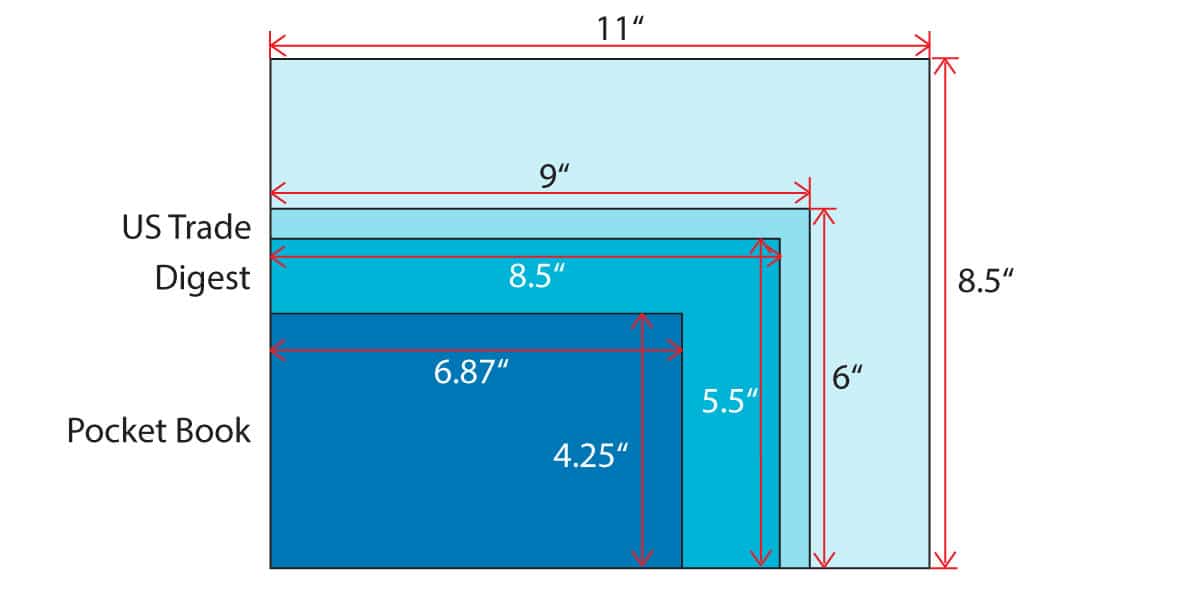
Pocket Book (4.25″ x 6.87″): It makes a great fit for cheap paperback fiction.
Digest (5.5″ x 8.5″): This compact size is often used for pocket-sized novels and mass-market paperbacks.
US Trade (6″ x 9″): This is a popular size for novels, non-fiction books, and general trade paperbacks.
8.5″ x 11″: This size is commonly used for textbooks, reference books, and educational materials — our 8.5 x 11 book printing handles this large format with ease.
United Kingdom
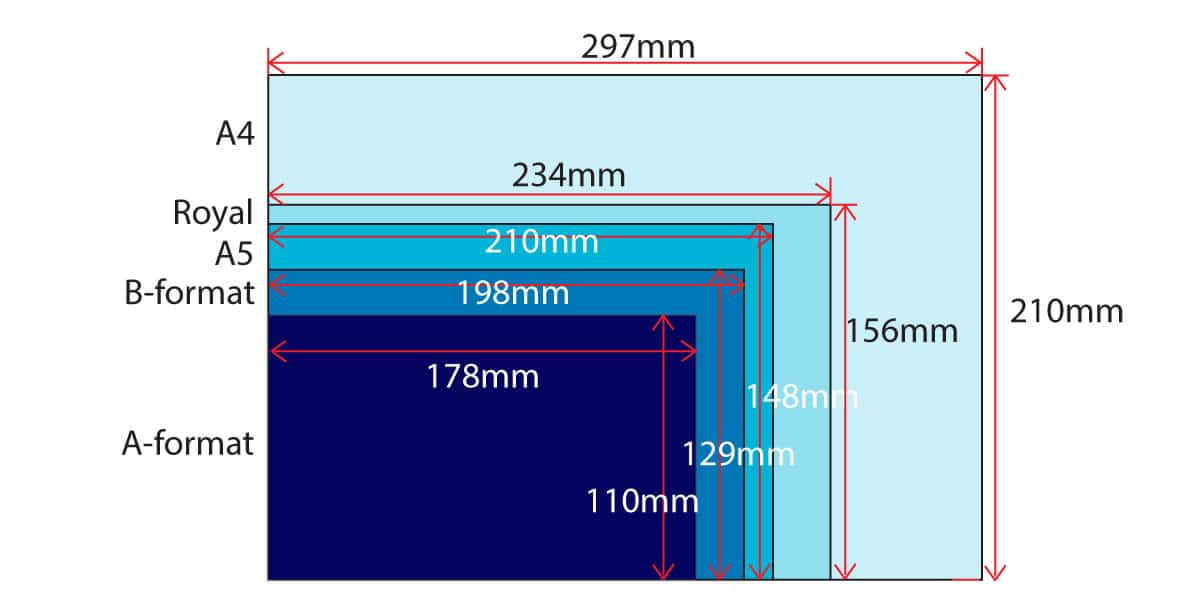
A-format (110 mm x 178 mm): This compact size is commonly used for pocket-sized paperbacks.
B-format (129 mm x 198 mm): This size is commonly used for trade paperbacks and larger-sized novels.
Royal (156 mm x 234 mm): This is often used for novels, non-fiction books, and other genres.
A5 (210 mm x 148 mm): This is often used for educational materials, journals, and smaller-sized books.
A4 (297 mm x 210 mm): This is a standard size for many printed materials, including books, reports, and documents.
Japan
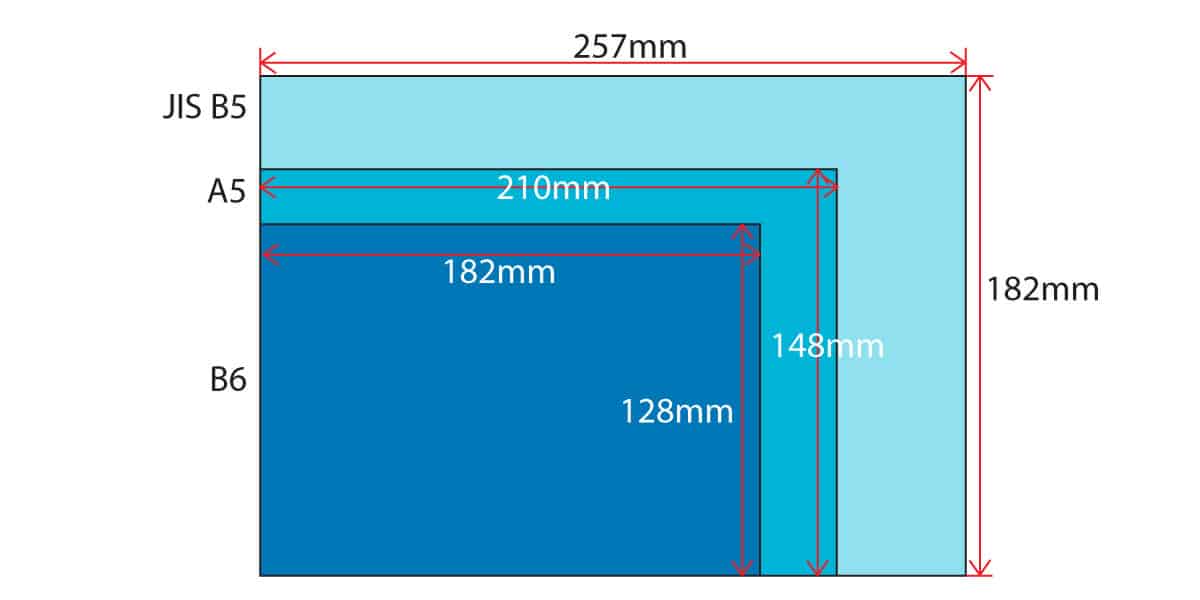
B6 (128 mm x 182 mm): This compact size is commonly used for pocket-sized books, manga, and light novels in Japan. It is favored for its portable nature and ease of reading.
A5 (148 mm x 210 mm): Similar to the European A5 size, the A5 size is also popular in Japan for novels, non-fiction books, and magazines — see our A5 book printing for this portable, reader-friendly format.
JIS B5 (182 mm x 257 mm): Standard size commonly used in Japan, often used for various printed materials such as books, magazines, catalogs, and documents
Australia
Demy (135 mm x 216 mm): is frequently employed for trade paperbacks and novels, providing a comfortable reading experience.
US Trade (152 mm x 228 mm): widely used for both fiction and non-fiction. It is a popular choice among authors and publishers.
A4 (210mm x 297mm): is highly favored for educational materials, particularly in the realm of book publishing – see our A4 book printing for this large, document-friendly size.
Legacy Standard (203mm x 254mm): is an excellent option for children’s books, especially hardcovers.
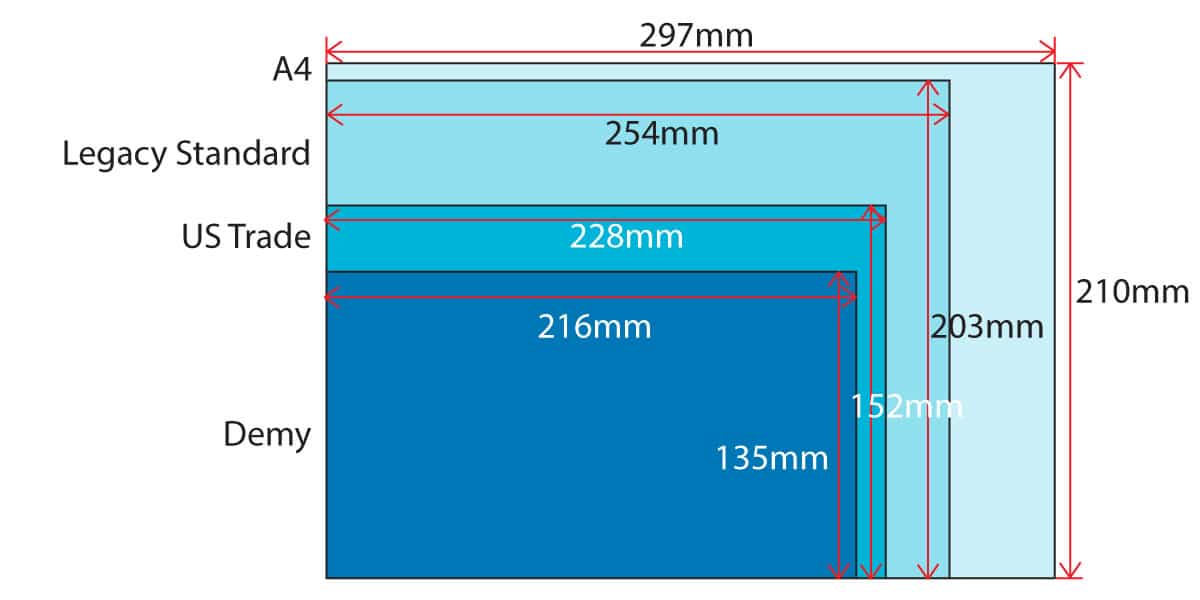
It’s important to note that these sizes may vary slightly depending on publishers and specific printing requirements. When choosing a book size, it’s advisable to consider the printing standards and reader preferences of the target country or market.
Considerations for Target Audience Expectations
When choosing the size of your book, it is important to consider the expectations of your target audience. This involves taking into account their age group, demographics, and reading habits.
Impact of Target Audience Age
The age of your target audience plays a significant role in determining the appropriate book size. Different age groups have distinct preferences and requirements when it comes to the physical characteristics of a book. Here’s how the age of your target audience can affect the choice of book size:
Children and Young Readers: board books sized around 5″ x 5″ or 6″ x 6″ are commonly used. These sizes make it easy for children to hold and handle the books. Picture books targeted at young readers typically follow standard sizes like 10″ x 8″ or 11″ x 8.5″.
Teenagers and Adult Readers: Adult readers encompass a wide range of age groups, and their preferences may vary. However, standard book sizes such as 5.5″ x 8.5″ and 6″ x 9″ are widely accepted for novels, literary fiction, and non-fiction books across various genres. These sizes are considered versatile and comfortable for adult readers, striking a balance between readability and portability.
Elderly Readers: Older readers, particularly those with visual impairments or age-related vision changes, may benefit from larger book sizes. Opting for larger dimensions, such as 6″ x 9″ or 7″ x 10″, can enhance readability for elderly readers by accommodating larger font sizes and increased page dimensions.
Considerations for Specific Genres
Different genres have established norms and reader expectations regarding book sizes. Here are some examples:
Fiction Novels: Genres like literary fiction, romance, mystery, and science fiction often follow standard book sizes like 5.5″ x 8.5″ or 6″ x 9″. These sizes are widely accepted in the publishing industry and familiar to readers.
Graphic Novels and Comics: These genres have their own size preferences based on industry standards. The most common size for graphic novels and comics is approximately 6.625″ x 10.25″. This size allows for optimal presentation of illustrations, text, and panel layouts, providing an immersive reading experience.
Educational or Reference Books: Books in these categories may lean towards larger sizes, such as 8.5″ x 11″, to provide ample space for detailed illustrations, annotations, and other educational content.
Considerations for Content Structure and Elements
The content and structure of your book also influence the choice of book size. Here’s how they can impact your decision:
Word Count and Page Count: The length of your book, indicated by the word count or page count, is crucial in determining the optimal size. A shorter book with fewer pages may appear awkward or sparse in a larger format, while a lengthy book may be cumbersome to handle in a smaller size. Strive for a size that strikes a balance between readability and practicality based on the overall length of your manuscript.
Elements: If your book includes visual elements, specific design elements, or additional features like tabs or fold-out sections, you may want to choose a larger format that can effectively showcase those elements. Sizes like 8.5″ x 11″ or 9″ x 12″ provide ample space for visually-oriented content, allowing images or illustrations to be presented attractively.
In conclusion, when deciding on the appropriate size for your book, take into account the expectations of your target audience, their age group, genre conventions, and the content structure. Strive for a size that complements the content, enhances readability, and presents the book in an appealing and functional manner.
How Book Size Affects Your Printing Cost
One factor that often surprises first-time self-publishers is that book size has a direct impact on printing cost — and not always in the way you’d expect. A slightly larger book isn’t always more expensive, and a smaller book isn’t always cheaper. It depends on how efficiently your chosen size uses the printing sheet.
Offset printing in China works by printing multiple pages on large sheets of paper at once. These sheets are then folded, cut, and bound. When your book’s trim size aligns neatly with a standard division of these press sheets — for example, exactly one-eighth or one-sixteenth of a full sheet — very little paper is wasted, and your per-copy cost is lower. When your size falls awkwardly between divisions, more paper is trimmed away and discarded, and you pay for that waste.
This is why certain book sizes are significantly more economical to print than others, even when they’re only a centimeter or two apart. If you’re working within a tight budget, or printing a large quantity, it’s worth knowing which sizes offer the best value.
The Most Economical Standard Book Sizes
The sizes below align well with standard Chinese press sheet divisions and are among the most cost-effective options we offer. If your planned size is close to one of these, consider adjusting your layout — the savings can be meaningful, especially at larger print runs.
| Size | Common Uses | Why It's Economical |
|---|---|---|
| 5.5" × 8.5" (140 × 216 mm) | Fiction, non-fiction, poetry | Efficient division of the large press sheet (1/16). One of the most popular sizes worldwide. |
| 6" × 9" (152 × 229 mm) | Trade non-fiction, self-help, business | Standard trade size. Aligns well with press sheet divisions and widely used in the industry. |
| 8.5" × 11" (216 × 280 mm) | Textbooks, art books, cookbooks, children's books | Exact 1/8 division of the large press sheet. Excellent paper utilization. |
| 6" × 6" (152 × 152 mm) | Board books, gift books | Efficient square format. Popular and cost-effective for short-run children's titles. |
| 8" × 8" (203 × 203 mm) | Children's picture books, photography books | Good press sheet efficiency. A slightly larger square that suits detailed illustration. |
| 10" × 10" (254 × 254 mm), 11" × 11" (280 × 280 mm) | Coffee table books, art books | Efficient large square format. Very popular for premium illustrated titles. |
If you have a size in mind that isn’t on this list, don’t worry — we can print at custom dimensions and will let you know if a small adjustment would reduce your cost. Just share your specs with us when you request a quote.
It’s also worth noting that size affects more than just paper efficiency. Larger books require heavier paper to prevent pages from bowing or feeling flimsy — for example, books larger than 8.5″ × 11″ typically need interior paper of at least 100–157 gsm to maintain a quality feel. This adds to the per-copy cost and is worth factoring into your budget alongside the trim size decision.
Frequently Asked Questions About Book Size
Q: What is the most common book size for self-publishing?
6″ × 9″ is the most widely used size for trade non-fiction, self-help, and business books. For fiction, 5.5″ × 8.5″ is equally popular and gives the book a slightly more compact feel. Both sizes are industry standards and are accepted by all major distribution channels and retailers.
Q: Does book size affect printing cost?
Yes, it can. Sizes that align well with standard press sheet dimensions — such as 5.5″×8.5″ and 8.5″×11″ — use paper more efficiently and typically cost less to print per copy than non-standard sizes. If you’re working to a budget, choosing one of these standard sizes is an easy way to keep costs down without compromising on appearance.
Q: Can I use a custom book size?
Yes. We can print at almost any trim size within our press capabilities. Custom sizes are a good choice when your content or design has specific requirements that standard sizes don’t accommodate. Keep in mind that custom sizes may cost slightly more if they result in less efficient paper use. When you request a quote, we’ll let you know if a small adjustment to your dimensions would save you money.
Q: How does book size affect page count?
The larger your trim size, the fewer pages you’ll need for the same amount of content — because each page holds more text. For example, a novel that runs to 352 pages at 5.5″×8.5″ might need only around 280 pages at 6″×9″ with the same font size and margins. This is worth considering when estimating your spine width and production cost.
Q: What book size works best for a book with lots of images?
For image-heavy books, a larger format generally works better — it gives each image more space and reduces the need for cropping or reduction. For photography and art books, 8.5″×11″, 10″×10″, or 11″×11″ are popular choices. For children’s picture books, 8″×8″ or 8.5″×11″ are widely used. If your book mixes text and full-page images, a square or landscape format can help the images feel more prominent.
Talk to us
At QinPrinting, we understand that choosing the right size for your self-published book is a critical decision that impacts its overall appeal, readability, and cost-effectiveness. Our team of experts is here to guide you through the process and provide high-quality printing services tailored to your needs. Contact us today to discuss your book project and receive personalized assistance in selecting the perfect size. We offer a wide range of standard sizes, including 5.5″ x 8.5″, 6″ x 9″, 7″ x 10″, and more, to cater to various genres and target audiences. Our state-of-the-art printing technology ensures exceptional print quality and attention to detail.
Don’t let the size of your book be an afterthought. Choose QinPrinting as your printing partner, and together, we’ll bring your self-published book to life with the ideal format and size that captivates readers and meets your budget. Request a quote and take the next step toward creating a professional and visually stunning book that leaves a lasting impression.